he Norwegian government provides scholarships for students from developing countries in the South and countries of Central- and East-Europe and Central-Asia under the Quota Scheme. The goal of the Quota Scheme is to promote the internationalization of higher education and give developing country students relevant education that would also benefit their home countries when they return after graduation..
Showing posts with label Online Exam. Show all posts
Tuesday, April 30, 2013
CLASS 12th MODEL QUESTIONS (2013) JHARKHAND
Posted by
Education & Exam Point
Labels:
Bank Paper,
Exam Paper,
Jharkhand,
Model Paper,
Online Exam,
Question Paper
at
2:34 AM
CLASS 12th MODEL QUESTIONS (2013)
ACCOUNTANCY
BIOLOGY (Botany+ Zoology)
BUSINESS MATHEMATICS
BUSINESS STUDIES
CHEMISTRY
ECONOMICE (COM & SCI)
ENTERPRENEURSHIP
MATHEMATICS
PHYSICS
ANTHROPOLOGY
ECONOMICS INTER (ARTS)
ENGLISH CORE INTER
GEOGRAPHY
HINDI CORE
HISTORY
HOME SCIENCE
PHILOSOPHY
POLITICAL SCIENCE
PSYCHOLOGY
SOCIOLOGY
CLASS 12th MODEL QUESTIONS (2013) JHARKHAND
Monday, February 11, 2013
online your Adhara No.
Posted by
Education & Exam Point
Labels:
ADDHAR CARD,
ON FORMS,
Online Exam,
ONLINE FORMS
at
3:42 AM
Wednesday, February 6, 2013
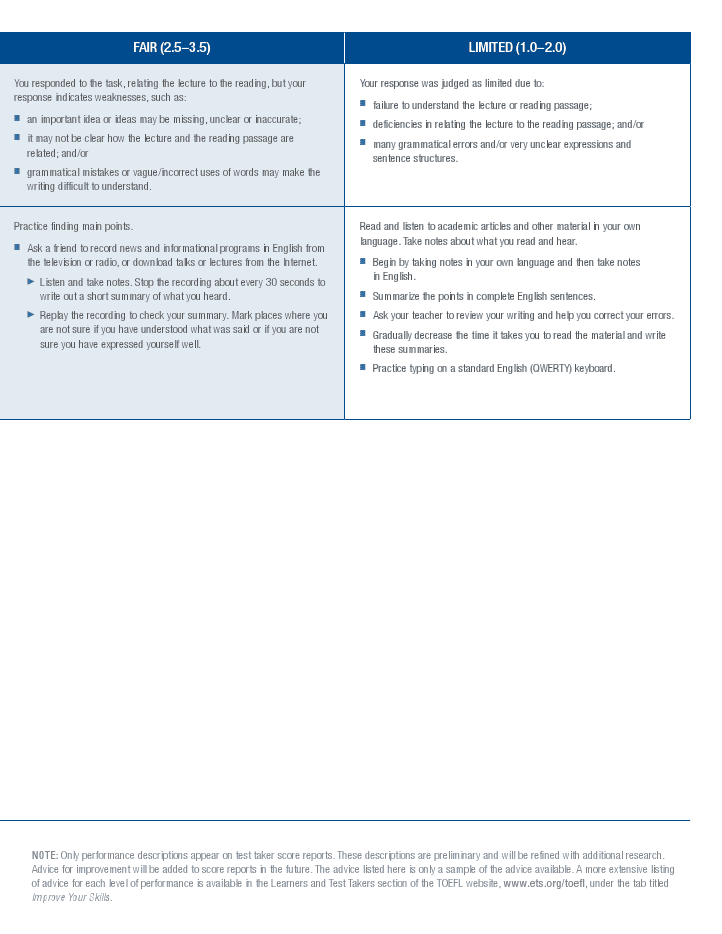
TOEFL Test Skills and Sample Reading Skills, Listening Skills, Speaking Skills, Writing Based
Posted by
Education & Exam Point
Labels:
Education,
Online Exam,
Question Paper,
Tofel Exam,
Top Level Exam
at
2:26 AM
Tuesday, February 5, 2013
Grammar Remediation and Enrichment (G.R.E.)
Course Goals:
The goal of Grammar Remediation and Enrichment (G.R.E.) is to provide an intervention solution for students
who have not yet mastered the fundamentals of grammar and its use in basic sentence composition. This
course will provide students with a clear understanding of grammar and sentence composition.
Course Objectives: The student will…
1. Demonstrate command of the conventions of standard English grammar and usage when writing or
speaking.
a. Explain the function of phrases and clauses in general and their function in specific sentences.
b. Choose among simple, compound, complex, and compound-complex sentences to signal
differing relationships among ideas.
c. Place phrases and clauses within a sentence, recognizing and correcting misplaced and
dangling modifiers.
2. Demonstrate command of the conventions of standard English capitalization, punctuation, and spelling
when writing.
Price: $15.00
ISBN: 978-1-58561-189-8
Bell-work: Students are to enter class and immediately begin their bell-work. Bell-work is a 5-10 minute
assignment that requires students to apply a previously taught grammar skill. Bell-work sheets are due once
every 2 weeks.
Grading Policy
All assignments will be weighted according to the following grading policy:
Assignment Type
Tests
Class Work
Homework
Projects
Quizzes
Weight
30%
25%
15%
20%
10%
Homework is an important requirement of the course. Homework is to be turned in on the assigned due date.
In accordance with Chesapeake Science Point Public Charter School homework policy, late homework
assignments will be given a grade of 0% unless the student has been absent.
Make-Up Work: It is the student’s responsibility to ask for make-up assignments after an absence. All
assignments will be maintained in a file cabinet labeled “While You Were Out.” In an event of an absence, the
student should locate the drawer with his or her grade level on it (6 th, 7th or 8th). Then, he or she should check
the folder labeled for the day missed. Make-up work will not be discussed during the actual classroom
instruction time. In general, students will be granted the number of days they were absent to complete any
make-up work.
Tardiness: Lateness without a proper pass will not be tolerated. The “Consequences for Breaking Rule or
Commitment” section below will be utilized for unexcused tardies.
Supplies: Please gather the following supplies and have them available to you by the end of the first week of
school. No pencils will be used in class at any time. Colored pens, other than blue or black, may be used for
notes only. All class assignments must be in blue or black ink. *See attached “Materials” sheet for images.
* Pens (blue or black ink only)
* A supply of clean, white paper
* Pencils
* 3-prong Duo tang Folder
* 4 Tab dividers
Folder Organization:
1st page- Classroom Procedures
Tab 1- Bell-work
Tab 2- Jingles
Tab 3- Notes
Tab 4- Other
Front pocket- homework
Back pocket- Graded assignments
Classroom and School Rules
Arrive to class prepared and on time.
Respect yourself and others. Profanity and any other inappropriate language will not be tolerated.
Remain in your seat unless otherwise directed by the teacher.
Refrain from eating and/or drinking during class.
Raise your hand, and wait to be called on before speaking.
All electronic devices are to be kept in lockers. Calculators should not be used during Language Arts.
Academic dishonesty of any nature will not be tolerated. All academic dishonesty cases will receive a
grade of “0” for that assignment and parents will be contacted.
8. Keep all hands, feet, and other objects to yourself. Inappropriate touching of any nature will not be
tolerated.
Additional Course Commitments
In addition to school rules, which are consistent in all classes at Chesapeake Science Point Charter
School, our class will establish additional expectations for behavior and treatment on the 1 st day of class.
Breaking of commitments will incur the same consequences as the breaking of school rules.
Consequences for Breaking Rule or Commitment
1. First offense = Warning
2. Second offense= 3 demerit points and possible conference with teacher
3. Third Offense = 5 demerit points and student is sent to “Cool Down” area to complete a
reflective writing assignment.
4. Fourth Offense = 10 demerit points, student is sent to “Cool Down” area to complete a reflective
writing assignment and parent is contacted (via email or phone).
5. Fifth Offense= Referral to office.
*Offenses that may cause harm to someone will automatically be dealt with at the 5 th offense level.
Classroom Procedures
Procedures are a part of life. We follow procedures for using a telephone book, boarding an airplane,
attending a wedding, driving, etc. The reason we have procedures in life is so that people can function
in society knowing the acceptable and efficient ways other people do things. There are also procedures
in this classroom. These procedures establish our classroom culture. They are as follows:
Procedure
Routine
Entering the
Walk into room (do not run) quietly
Classroom
Locate and sit in the desk with your assignment number
Get to Work
Look to the projector and begin the assigned bell-work on the
ASAP
“Bell-Work” sheet given to you (and brought to class daily).
End of Class
During the last few minutes of class the teacher will instruct the class to:
o Take out agendas
o Record homework and other reminders
o Prepare for dismissal
Dismissal
Do not leave when the bell rings. Sit at your desk quietly and wait to be
dismissed by teacher. Once you are dismissed:
o Push in your chair
o Take all your belongings
o Pick up and throw away any trash on and around your desk
o Exit quietly and calmly
Finish Work
Start on your homework OR
Early?
Read or work on B.O.B. activity
If the Teacher
Keep working
Steps Out
If no work has been assigned yet read or work on B.O.B. activity
Bathroom,
You will be given 3 tickets for the 9 weeks. You cannot get permission to leave
water or other
the room without them.
reasons to
No one is allowed to leave the room during the first and last 20 minutes
leave class
of class
Absent?
Check the absent drawer the day you return
If necessary meet with the teacher
Paper Heading
Top right:
o Assigned number, First and Last name
o Date
o Period #
o 7th grade LA
Library/ other
Single file in blue floor lines
class trips
Steady pace
Quiet
Getting Attention
How I will get your attention:
o I will say “Attention!” and clap once. If necessary I will repeat and clap
twice. When you hear this:
Freeze
Turn and face me
Be ready for instruction. I will have something to say.
How you will get my attention:
o Raise your hand and wait for me to call on you. It may seem that I will
not see you soon, but I promise that I will. Just keep you hand up and
wait quietly.
THIS IS YOUR CHILD’S FIRST HOMEWORK ASSIGNMENT
Parents: Parents are a valued aspect of education. Please feel free to contact me if you have any questions
or concerns. You may contact me at school, and I will return your call as soon as possible. You may also
contact me via email at emckinney@mycsp.org.
Please read the syllabus with your child and return this portion by Friday, August 26. Students who do not return
the syllabus by Friday, August 26 will receive a grade of “0.” We will also be discussing the information during
the first week of class.
I have received the syllabus and understand all policies and procedures described within. I also understand
that in accordance with Chesapeake Science Point Public Charter School homework policy, late homework
assignments will be given a grade of 0% unless the student has been absent.
___________________________________
Printed Parent/Guardian’s Name
___________________________________
Students Printed Name
_____________________________
Parent/Guardian’s Signature
_____________________________
Student’s Signature
______________
Date
______________
Date
Sunday, February 3, 2013
Step by Step Guide to apply for MS in US GRE and TOEFL exams
Posted by
Education & Exam Point
Labels:
Education,
GRE,
Online Exam,
Others,
Tofel Exam,
Top Level Exam
at
12:51 AM
Step by Step Guide to apply for MS in US
Why study in the USA?
Well Students prefer USA because a degree from a US university is recognized globally.
It gives you a platform for excellent career growth. There are various factors. The
academic world in the US is far more diverse in terms of educational resources. The
educational system exploits the student's strengths and abilities to the fullest.
Thousands of students go to the US annually for higher education. Many students who
consider an education in US fail to get sufficient information and advice based on their
individual needs and abilities, as well as the many differences in American
universities.As a result they may secure admission in a university with expectations that
cannot be fulfilled. To avoid finding yourself in such a situation plan well in advance and
obtain all the information you need.
The procedure to apply to the universities in USA.
1. Give your GRE and TOEFL exams. If possible decide on at least 3 or 4
universities before u give the exam. This will help you save a lot of money: (15 * 4
= $60) on GRE score reports and (17*4 = $68) on TOEFL score reports. ETS
sends official GRE score reports to 4 universities and official TOEFL scores to 4
universities free of cost.
2. For the GRE exam solve as many papers as possible.
3. If you are applying for the fall semester (starts in August) then send your pre-
application (request the university to send the form and brochure) by May or first
week of June.
4. Once you receive the forms and brochure, decide on the universities that you are
going to apply to. The choice of the university should be made based on the
following factors:
*The university should offer the field of your choice.
*The ranking of the university should suit your needs.
*If you need aid, it is normally the highly ranked universities that have funds.
msinusblog.com – reference blog for international students who want to apply to graduate schools in US
Choose universities that have sufficient funds i.e. the university should be known
to have offered many scholarships in the past.
*Choose universities where you have seniors (performing academically well
there) so that they are positively disposed towards you (and other students from
your college here).
5. Once you have decided on the universities, take recommendations from 2 or 3
professors as per the requirement of the university.
6. Apply for official transcripts from college.
7. Preferably finish the recommendation and transcript work in October because
professors tend to go on vacation towards the end of the semester (i.e.
November).
8. Write your Statement Of Purpose (SOP).
9. Fill the application form and also send a resume with each application
10. The financial document is not a necessity for admission. It can be submitted after
the admission is received.
11. With each application the following documents should be present even though
not explicitly mentioned in the form :
*Statement of Purpose
*Recommendations
*Resume
*Photocopies of certificates (if applicable)
*Photocopy of GRE and TOEFL score report
*Checklist stating the list of items in the packet
*If you aren't sending the financial document, then write a letter stating that you
will send it later.
*If you have undergone training then make a separate list of courses done
*Emphasize on the work experience
msinusblog.com – reference blog for international students who want to apply to graduate schools in US
Application Time Table
June-August
* Think about your educational future and career prospects at home
* Talk with your family about financial resources
* Read the section on Selecting a University
* Visit an educational advising center and become familiar with the application process.
* Register for tests such as the TOEFL, SAT, SATII, GRE, or GMAT
August-November
* Take entrance tests
* Attend university fairs
* Research universities and identify between four and ten that meet your needs
December-March
* Pay careful attention to deadline dates.
* Submit a winning application to at least three universities
April-May
* Letters of acceptance or rejection arrive.
* Read acceptance letters carefully. Many institutions require a separate application for
housing.
* Choose the university you want to attend.
* Send letters of regret to universities you will not attend.
* Seek information about applying for a visa
June-July
* Apply for a student visa
* Make travel arrangements
* Attend a pre-departure orientation program at your school or at an educational
advising center.
August
* Arrive in time to attend the university’s orientation program for new students
* Be prepared for an excellent academic experience
msinusblog.com – reference blog for international students who want to apply to graduate schools in US
What is Graduate Record Examination (GRE) ?
The GRE is one of the most important examinations to be taken by a student aspiring to
go for further studies abroad. The GRE is a Computer Based Test (CBT) . You need to
know about the testing style which is vastly different from the paper based testing
format .The CBT is an adaptive test and the level of difficulty increases with each
correctly answered question.
The first few questions are supposed to be very important from the scoring point of
view. The score does vary a lot on account of later questions but the initial questions are
make or break.
Some important points about the GRE:
1. It is required for admission to most universities in the USA.
2. Take it once and properly. Not only is it costly but also time consuming to go through
the rigours of taking the GRE.
3. Some Universities consider the latest score, some the best score and some the average
of all scores. So don't take a chance with the GRE. Take it when you are really well
prepared.
4. The GRE score is valid for 5 YEARS.
When to appear for the GRE?
1. The best time to take the GRE is 5TH SEM / 6TH SEM.
2. The last you can take the test and be in time for deadlines is 7th sem.
3. Register for the GRE well in advance so not to miss the test during the intended
period and also to avoid going too far off cities such as Bangalore to take the test.
The Official GRE Page
msinusblog.com – reference blog for international students who want to apply to graduate schools in US
GRE preparation Tips
You need to prepare sincerely for at least 3 months. Actually it also depends on the
individual taking the test. If you are good at the word lists (VERBAL) then it would take
you much less time. But the verbal section is the one which makes the difference
between a good score and an excellent one. So do all the 50 word lists from BARRON'S
properly. It sure goes a long way in improving your GRE score.
For analytical sections , practice as much as possible. Take as many tests / sections for
this. It would help to take both the paper based and CBT for practice. Though the
scoring would be certainly different on the paper based tests , the practice is invaluable .
Also many CBT tests would not be easily available so the CBT alone would not be
sufficient practice.
Nowadays, the Quantitative section is becoming tough . Questions on probability ,
statistics are appearing on every test . It would be advisable to ask friends who have
appeared for the CBT before on the type of questions that appeared on the test.
GRE Preparation Tips
http://www.petersons.com/testprep/default.asp?id=880&path=gr.pft.gre
msinusblog.com – reference blog for international students who want to apply to graduate schools in US
What is TOEFL?
Test of English as a Foreign Language (TOEFL)
Most of the Universities also make the TOEFL a compulsory test. The TOEFL is a very
simple exam for most students from an English medium background. Compared to the
Verbal section of the GRE, the TOEFL is a cake walk.
Most universities require a score of 80 / 120 in TOEFL iBT and 213/300 in TOEFL CBT.
It is easy to score much more than this.
When to appear for the TOEFL?
1) The best time to take the TOEFL is 6TH SEM / 7TH SEM.
2) The last you can take the test and be in time for deadlines is 7th SEM.
3) Register for the TOEFL well in advance so not to miss the test during the intended
period and also to avoid going too far off cities such as Bangalore to take the test.!
TOEFL preparation
For the TOEFL, the preparation required is meager. Most students just take all the tests
from the Barron’s. Other preparatory material is Princeton's
The Official TOEFL page
Click Here
TOEFL Preparation Tips
http://www.petersons.com/testprep/toefl.asp?id=3567&path=ug.pft.toefl
TOEFL iBT Pattern and Details.
I wrote TOEFL iBT and before taking the test I had two options, either to take TOEFL
CBT or TOEFL iBT. All my friends recommended me to take CBT since they said that
the new pattern has speaking section and so the old pattern in much easier. But I still
went ahead and gave the iBT pattern. Well to be true the new format is quite easy and
msinusblog.com – reference blog for international students who want to apply to graduate schools in US
you can score high with a little bit of preparation. The speaking section is not that tough.
The only tip which I would like to give you guys is that don't try to speak differently.
They are not looking for American accent. Since you are speaking into the microphone
the only thing you have to do is speak slowly and clearly, yes I would emphasize on the
word clearly and you will end up with a high score. Well don't get tensed by seeing other
speaking really fast English. Be relaxed and take your time.
Well for more details on the TOEFL iBT pattern and details go to
http://www.petersons.com/common/article.asp?
id=1149&path=gr.pft.advice&sponsor=1
Tips and Strategies
http://www.petersons.com/testprep/tips.asp?id=3569&sponsor=1&path=gr.pft.toefl
http://www.petersons.com/ugchannel/file.asp?id=1073&sponsor=1&path=gr.pft.toefl
Test Info
http://www.petersons.com/testprep/test_info.asp?
id=3570&sponsor=1&path=gr.pft.toefl
msinusblog.com – reference blog for international students who want to apply to graduate schools in US
Tips for Statement of Purpose (SOP)
The SOP is one of the most vital components of your application packet. The SOP is a
personal essay which is to be written by each applicant. The SOP is supposed to give a
clear idea to the admissions committee about your goals and academic interests.
The SOP is generally one page long made up of 4 - 6 paragraphs. The SOP must address
the following issues:
* Reason for pursuing higher studies.
* Research and academic interests
* Goal in life
* Personal strengths and weaknesses
* Academic and other achievements
* Related experience / projects undertaken
* Reason for applying to the university
It is a good idea to go through the SOPs of your seniors and other students applying to
other departments .Get your SOP checked for errors and grammatical mistakes.Such
errors will create a bad impression and may prove costly.
Start working on your SOP by September end try and get it done by October.
Also Check out these websites
http://www.statementofpurpose.com/
http://www.infozee.com/application-issues/sample/sop-engg.htm
http://www.desigrad.com/~desigrad/desi_grad/sop.php
http://www.desigrad.com/sop.php
http://www.achieverspoint.com/apply/samplesop.htm
http://www.infozee.com/channels/ms/app-issues/sop.htm
msinusblog.com – reference blog for international students who want to apply to graduate schools in US
Tips for Letters of Recommendations (RECOS)/ Recommendation Lettters
The Letters of recommendations are a vital part of the application package. These
RECOS are letters from your professors who have taught you during your under
graduate course. All most all the universities require that you send 3 recos.
The recos should ideally be from professors who have taught you core subjects in your
field of specialization eg Operating Systems, TCS .
You can also ask professors who have taught you subjects such as Applied Mathematics
and Discrete Structures, for recos.
A recommendation letter from the HOD of your major field is very vital and would
definitely be an edge over the completion.
Do all professors write their own recos?
Well, some professors write the reco themselves while some ask the students to write it
themselves according to a pattern. If the professor writes the reco himself, it saves you
the trouble. But if you have to write it yourself you have to be very careful.
Remember that many of your class-mates might take recos from the same profs and also
might apply to the same places.So you must be extra careful while writing the reco. You
can ask some of your friends or family members to write a reco for you. One you can
write on your own.The aim should be to try and see that the 3 recos sound as if written
by different people and not written by the same person. You should also try and
highlight your plus points and academic achievements in the 3 recos. Try and focus on
different aspects in the 3 recos such has programming skills, team work , motivation for
future studies , academic performance with respect to the class ie top 10 % of the class
,etc.
Some Universities have their own reco formats?
Some universities send recommendation forms in their own format. They have columns
where the recommender compares the student with his batch mates on various
grounds . These could be mental ability, team work , motivation for higher studies ,
verbal skills , expressiveness etc. Basically the same things which are written in the reco
by the professor or rather by you!
If possible you must ask the professor to fill these forms as well. Some professors may
not fill them. Generally these are optional and the university says so in the brochure.
Whenever in doubt you must contact the college by email and clear your doubt.
msinusblog.com – reference blog for international students who want to apply to graduate schools in US
The recos are also to be sent in sealed envelopes with the signature of the recommender
on the flap.
When do I ask for recos?
Since the whole application procedure is so lengthy and time consuming, you should try
and be on your heels throughout the application stage. Many professors may not give
recos to all students or if they have already given a lot of recos. Approach the professors
well in advance and let them know of your academic pursuits and that you would like
them to write a reco for you. Even if you take the actual reco much later , once the prof
assures you of a reco , he won’t refuse you later.
If you plan to get the college reco forms filled as well as sending a typed letter, then you
will have to finalize your univs first. Also ask the prof if he would be filling in the college
forms as well. Thus, how quickly you get the recos done in this case , depends on how
fast you finalize you univs.
But just with the intention of doing this first or early, don't compromise on the effort
that you put in shortlisting your univs. This is crucial.
On the other hand if you intend to send only the typed letter then you can get the recos
done a little earlier.
Also Check out these websites
http://www.statementofpurpose.com/recos.html
http://www.dickinson.edu/career/files/lettersofrecforfaculty.pdf
http://career.berkeley.edu/Grad/GradLetter.stm
msinusblog.com – reference blog for international students who want to apply to graduate schools in US
Sample Resume for MS in US Application
TIPS FOR RESUME
The purpose of a resume is to disclose your accomplishments and
qualifications to the admissions committee. Think of your resume as a
promotional brochure about you. You need to show the committee what you have
accomplished and where your experience lies. Your strategy should be to emphasize the
experience and skills that a particular school is looking for. Your resume is also an
example of your communication and
organizational skills.
Selecting the right format.
There are several acceptable formats for a resume. Based on the amount
of your work experience, you can use one of the following formats:
Chronological:
This is the most common resume style for people with significant work
experience. In the Chronological format, the emphasis is placed on
employment experience. The applicant's job history is presented in reverse
chronological order, with the most recent jobs placed at the top of the list.
Functional:
In this non-linear format, your skills and achievements are emphasized.
Your employment history is summarized and linked to your skills and
achievements. Your skills and previous relevant experience (including
educational experience) are presented at the beginning of your resume. The Functional
resume can be particularly effective if you've held a number of similar positions; it will
allow you to highlight your skills rather than itemize what might be a redundant looking
job history.
Combination:
The Combination resume is simply a Functional resume with a brief
employment history added. Educational qualifications are listed first,
skills and accomplishments are still listed next; the employment history follows. You
need to reveal where you worked, when you worked, and what your job position was.
Emphasize your talents and show how you used them at the job.
msinusblog.com – reference blog for international students who want to apply to graduate schools in US
School Specific:
Some schools specify the format for the resume. In most cases, you
will be asked to include all part-time and full time work experiences,
research and project activities, extracurricular interests and
community/civil activities.
Resume writing tips:
Keep it concise
Resumes should be one page, if possible, and two if absolutely
necessary to describe relevant work experience.
Make your words count.
Your use of language is extremely important; you need to sell yourself
to a committee quickly and efficiently.
Avoid large paragraphs (over six or seven lines).
Use action verbs such as "developed," "managed," and "designed" to
emphasize your accomplishments.
Don't use declarative sentences like "I developed the..." or "I
assisted in..."; leave out the "I."
Avoid passive constructions, such as "was responsible for managing."
It's not only more efficient to say "Managed," it's stronger and more
active.
Make the most of your experience
The admissions committee is looking for future business managers and
leaders. They need to know what you have accomplished to have an idea of what you can
add to the program.
Don't be vague. Describe things that can be measured objectively.
Telling someone that you "improved warehouse efficiency" doesn't say much.
Telling them that you "cut requisition costs by 20%, saving the company
$3800 for the fiscal year" does. Employers will feel more comfortable
hiring you if they can verify your accomplishments.
Be honest. There is a difference between making the most of your
experience and exaggerating or falsifying it.
msinusblog.com – reference blog for international students who want to apply to graduate schools in US
Don't neglect appearance
Your resume is the first impression you'll make on the committee, and a
successful resume depends on more than what you say; how you say it
counts as well.
Check your resume for proper grammar and correct spelling - evidence of
good communication skills and attention to detail. Nothing can ruin
your chances of getting an admission more than submitting a resume filled with (easily
preventable) mistakes.
Make your resume easy on the eyes. Use normal margins (1" on the top
and bottom, 1.25" on the sides) and don't cram your text onto the page.
Allow for some breathing room between the different sections. Avoid
unusual or exotic font styles; use simple fonts with a professional look.
Eliminate superfluous details
Unnecessary details can take up a lot of valuable space on your resume.
Don't mention personal characteristics such as age, height, and marital
status on your resume. This information is either irrelevant or is
taken care of in other parts of the application. List your hobbies and
interests and extracurricular activities if these are not covered
elsewhere.
For Sample Resumes go to
http://www.i20fever.com/samples/resume/index.html
For Sample Resume for Master of computer science
http://www.asher.com/pdf/ENGRESUME.pdf
msinusblog.com – reference blog for international students who want to apply to graduate schools in US
Sample Cover Letter for MS Application
Covering Letter
ABC
B.E Computer Science
XXXXXXXX
XXXXXX
XXXX
XXXXXX
INDIA.
Dear Sir/Madam,
Subject: Submission of application form to Graduate School for MS (Computer Science)
for fall 200X.
I am aspiring student to have further studies at your esteemed university. In regard with
this I am applying for your graduate school for M.S Degree in Computer Science for the
Fall 2003. I am sending all the necessary documents along with filled application form.
Enclosures are as follows:
1.Application DD ( if not payed online)
2.Filled Application form (if not submitted online)
3.An official bank statement and a copy of Affidavit of Support given by Sponsor
4.A copy of Resume(Bio-data)
5.A Statement of Purpose(SOP)
7.Copies of 11th+12th Marks list- Attested by institution head.(2)
8.Copies of B.Tech Memos- Attested by Institution head and University Registrar.(2)
9.Recommendation letters given by HOD and Lecturers.(3)
10.Copies of GRE and TOEFL score reports.
Miscellaneous Documents
1.Prabhava-Paper Presentation certificate (Software Architecture)
2.Service Certificate- Loyola Academy.
Please take note of the following:-
• My university (univ name) does not have the practice of sending Transcripts directly to
universities, so in order to authenticate my transcripts I have requested them to seal and
sign across the envelope.
• I have not produced the Recommendation letters in the format given by you. My
Professors have given their Recommendations on their own letter pads. I request you to
accept my Recommendation letters, which are in a different format.
msinusblog.com – reference blog for international students who want to apply to graduate schools in US
University Expenses including Tuition Fee, Living Expenses etc.
Tuition Fees
US Universities fall under two major categories: public (state supported), and private
(independent) institutions. International students’ tuition expenses at state schools are
based on nonresident costs, which are still usually less expensive than those of private
universities. It’s important to note that the cost of a program in a US school does not
necessarily affect its quality.
A brief idea can be had from the following :
University Type Tuition Fees (annual in U.S. Dollars)
Private Institutions (High Cost) >$ 25,000
Private Institutions (Low Cost) >$ 16,000
State Institutions (High Cost) >$ 17,000
State Institutions (Low Cost) >$ 9,000
The tuition fee is different for different universities and varies widely with courses. It
can vary from as low as $ 9000 a year for state universities to as much as $ 30000 per
annum for some private universities. For more specific details, please contact the
universities.
Living Expenses
The approximate annual living expenses are about $10,000, which includes
accommodation as well as other daily expenses. However, the expenses are different for
different people depending on the lifestyles and this is just a rough idea.
So, about $1000 per month is a good estimation. Most people can survive with $700-
$1000 a month. The key here is to share apartments/houses so that you save on the
utilities, fixed charge portion of phone and to some extent on groceries.
Financial Aid & Scholarships
Financial aid is an important factor to consider for students applying abroad. Careful
planning is both necessary and wise. Foreign nationals are required to show proof of
sufficient funds to cover at least the first year of their college education to apply for a
student visa. To compare the total cost of studying in various countries, check out Cost
of Education
The burden of securing necessary funding can be challenging, and sometimes
frustrating. Your savings (or your family's) may be the only reliable source of funding
msinusblog.com – reference blog for international students who want to apply to graduate schools in US
you have as you begin your program of studies abroad.
Important: University funding is easier to get in the United States
than in U.K., Canada, Australia or New Zealand. Most students who go to
Australia and U.K. are self funded students.
All about Financial Aid
What is financial AID?
“AID is not free money, one need to work to get money!”
The following form of support is what I refer to as financial AID
· GRA-Graduate Research Assistantship Task: work under a prof , research
· GTA-Graduate Teaching Assistantship Task: Help a prof in class, grading, Lab -
· GA-Graduate Assistantship Task: Work for department eg:webmaster
· Fellowship (rare) Task: Paid for research to very talented guys
And NOT
· SCHOLARSHIP of $3000 or $5000, partial waivers given by some schools, this is not
AID. This is a trap!
Fee?
International students are expected to take 9 credit hours (3 courses) and the general
fee for this will be
Out sate fee: $ 6000 to $ 12000 per SEM
Instate fee: $3000 per SEM to $6000 per SEM
International students are supposed to pay out state fee but with a TA or RA from the
university you pay instate fee; some Univs even waive instate fee for RA’s or TA’s
What do we get if we have TA, RA or GA?
University will waive the students out-state fee and pay you salary- if you get a 10 hour
RA the general salary is 600-700 per month and a 20 hour RA/TA makes 1200-1500$ a
month. (Based on the pay rates of the school). If you get a RA for 10 hours, if you want
you can work for 10 hours in library or anywhere in the campus, International students
are allowed to work for 20 hours a week.
“I got waiver of $ 3000, I got AID”- NO (Why scholarship is not AID)?
Partial waivers are given generally in schools (low ranked schools), which don’t have
money/grants/resources to conduct research and thus no money to pay the students as
a RA/TA/GA Generally students who get a partial waiver never end up getting an RA or
TA, in other words you are given 3000 and made to pay 20,000.
Fee per semester in such schools is generally high, say 10000 per SEM @ 4 sems will be
a total fee of over 40,000 USD. Now these schools attract the students by offering a
msinusblog.com – reference blog for international students who want to apply to graduate schools in US
waiver of $ 3000-5000, but the truth is you are paying the remaining $ 35,000. Trust
me this is how it works.
Education Sector in the US Is a big business, these guys are here to make money, the
Education sector in US makes close to 15 billion dollars which is more than what India
makes on IT per annum (we call ourselves as the IT capital of word, huh)
Naveen you are wrong – “my school said I got 3000$ waiver now I may get RA/TA also
after I come to US?
These schools first of all don’t have many Assistantships (TA’s or RA’s), they will have
some but Look when every student is given 3000$ waiver, every student who applied to
this school and got an admit come here because of that waiver, so result more
competition. Finally you won’t get AID?
Not Convincing! Ok, let me defend --What are top ranked schools? Schools that have
research money and grants and places where there are many Undergraduate students
attending.
“We are masters- Graduate students, why are we bothered about undergrads”- TA or
teaching assistant positions are given based on the number of undergrad students, if
school is a good school and more number of Americans attend it; we have more number
of TA’s and more number of Campus jobs- Also federal grants to schools and the other
Govt agencies also depends on number of undergraduate students, if school has good
number of UG’s they good federal grants. Bottom line Department and profs have
money to do research and they hire us to work. Just think: So now your school has not
many Under-grads where will it create the TA positions?
General Trend
· 80 % of students in top 60-70 ranked schools get some form of support or the other
· 40-60 % of students get financial aid in first semester and the remaining get financial
aid after second semester.
· Getting funding from India is hard/ rare as a professor cannot decide if you a good
match for his research
MS in US Application and Admission General FAQ'S
What are the MS requirements?
For masters you have to take courses and do a project. Usually MS requires anywhere
between 30 & 36 credits. For thesis option you take less courses and do a big thesis
project and for non thesis you take more courses and do a small project. So say in a
thesis option you have to do 9 credit hours of research (project) you either take it from
the first semester you come here or hence forth. You can also take 3 credit hours of
msinusblog.com – reference blog for international students who want to apply to graduate schools in US
research in one semester and remaining in other semesters. And along with the research
credits you have to take courses. What you can also do is finish your course
requirements and then take research credits. If you are funded from the beginning, then
your advisor might want you to spend some time on research, so he will say take 3
research credits from now along with the courses. So it depends in which situation you
find yourself in. This might sound complicated to you, but do not worry as soon as you
go to US you will understand it.
Is work experience essential for MS ?
For MS generally work experience is not required. I think if you do (very) well in GRE
and your academics, your chances of getting financial aid increases.
What are credit hours/credit points/ degree credits? (Very Important)
Usually students do not bother to understand this term. But it is very essential that one
knows what exactly this means. Every regular subject/course is scheduled for 1 to 5
hours/week. That number is the credits (nothing but the number of hours you put in a
week) you get for that subject. A Masters program consists of a required number of
credit hours, which varies from University to University.
Want to know about the grading system in US?
Universities use alphabets to grade the quality of the students academic performance.
A(4=excellent), B(3=good), C(2=average), D(1=below average) and F(0=fail). You need
to score grade B or more to continue your graduate study.
What is the Grade Point Average (GPA)?
A system of recording academic achievement based on an average, calculated by
multiplying the numerical grade received on each course by the number of credit hours
studied. :-) Ok stop cursing us for that definition. Here is an example that will put the
smile :-) back on your face. Suppose you have taken 3 courses: X, Y & Z each with a
credit hour requirement of 3. Assume your grades in the 3 courses are A, B & A
respectively. Then your GPA will be calculated as : X : 4 * 3 = 12 Y : 3 * 3 = 9 Z : 4 * 3 =
12 Total = 12+ 9 + 12 = 33 GPA = 33 / (3+3+3) = 3.66 That should have made things
clear!!
What's a major?
The area of studies in which you wish to concentrate. This is usually EE (Electrical
Engineering) or CS (Computer Science) or CE (Computer Engineering). Mind you, the
area of specialization differs from a major in that, it is the field in wish to do some
msinusblog.com – reference blog for international students who want to apply to graduate schools in US
research viz. VLSI, Computer N/W, Parallel Computing, DSP etc.
How many years does it take to complete MS ?
Masters takes time. On an average it takes 2 years. You have to be very good to finish it
in 1 year. 1.5 years is possible but its safer to think that it will take 2 years. Many
Universities offer a 1 year accelerated course which may sound tempting. But think
carefully before you decide to go for this. It is extremely hectic. Some
students have found even 2 year a tough job.
What to write in an SOP ?
The SOP is supposed to identify to the Univ. what your (1) Interests are in the field you
plan to major in. For e.g.. one can write that he/she is interested in Software
Engineering and Networking. You need to mention why you are interested in these
areas. Maybe you did a project and found yourself drawn to those aspects of the project.
(2) Future plans are. Do you want to get into academia or industry. Either answer is OK.
What role do you see yourself playing wherever you land up (are you going to be a
technical person, a researcher, a teacher). You don't have to get very specific, but you
should think about these things carefully.
Is TOEFL necessary for admission?
If your native language is NOT English and/or you do not have a degree from a
university in an English-speaking country, you will be asked to provide evidence of
English proficiency. Most universities require scores from TOEFL while some
universities administer their own test upon arrival on campus, and a growing number of
universities are accepting the scores from the IELTS. • TOEFL-The Test of English as a
Foreign Language measures the ability of nonnative speakers of English to use and
understand North American English as it is used in college and university settings.
Many universities have a minimum score required entrance to the academic program.
Students with lower scores will be required to take an intensive English language
program. The test is offered on computer throughout most regions of the world. In areas
where access to computer-based testing is limited, a supplemental paper-and-pencil
version of the test is administered. For further information, visit www.toefl.org. •
IELTS-International English Language Testing Systems tests the complete range of
English language skills which will commonly be encountered by students when studying
or training in the medium of English. All candidates take the same Listening and
Speaking Modules. There is an option of either Academic or General Training Reading
and Writing Modules. The Academic option is suitable for candidates planning to
undertake higher education. For further information, go to www.ielts.org.
Why study in the U.S.?
•Worldwide recognition of U.S. degrees •Employers favor U.S. degrees •Wide range of
msinusblog.com – reference blog for international students who want to apply to graduate schools in US
educational programs •U.S. universities spend $20,000 per year on each student
compared to $7,225 in Britain, $11,572 in Australia, $12,217 in Canada •Outstanding
facilities, libraries and laboratories •Diverse student body •Opportunity to spend an
additional year in the U.S. getting valuable, relevant work experience
How to Calculate Expenses?
Calculating expenses • Tuition – the cost of instruction is generally charged as a single
amount for the term (semester/quarter). Some universities, and many graduate
programs, based their fees on the number of credits students take • Fees • health
insurance • student activity fee that gives students access to the library, health center
and campus activities • out-of-state fees charged by public universities to ALL students
who cannot prove they are residents of that particular State. • Living Costs • room and
board • transportation • books and supplies
How to obtain a Student Visa?
To obtain a student visa, you must demonstrate that you: • Have the ability and
intention to pursue a course of full-time study. This can be demonstrated by official
acceptance from the college or university that you wish to attend. Some visa officers will
also want to see transcripts and test scores or discuss your plans further. HINT: Be
prepared to tell the visa officer what you want to study, where you want to study, how
you are going to finance your stay in the United States, and what you intend to do with
your degree when you return to your home country. Be prepared to do this clearly and
quickly. • Possess adequate funds to cover all of the costs listed by the university on the
I-20 or IAP-66 form that they will send to you when you are accepted. These costs
include tuition, fees, living expenses, and incidental expenses. As a general rule, the
consular official will want to see a bank draft in the amount of the first year’s expenses
and documentation showing how the money will be found for future years. • Have
sufficiently strong social, economic, and other reasons to leave the United States upon
completion of the projected program of studies. Such reasons can be shown during the
visa interview (if an interview is required), by such means as showing strong family ties
in your home country and/or excellent employment prospects when you return home
with a U.S. degree. • Are able to articulate your reason for studying at a specific
institution
For more Faq's go to
http://www.educationusa.state.gov/faq.htm
Tuesday, January 29, 2013
Kaun Banega Crorepati Registration - Individual
Posted by
Education & Exam Point
Labels:
General Knowledge,
Interview,
Interview Questions,
Interview Tips,
Online Exam,
Others
at
7:13 AM
Kaun Banega Crorepati Registration - Individual
Q. Who can register?
A. Anyone who is an Indian citizen, residing in India, of 18 years or above as on May 25, 2012 and the
citizen should be of sound health and mind can register for KBC. No person can participate on
behalf of another person..
Any Contestant who has made it once to the Fastest Finger First round of the current season of the
Competition or the last 2 seasons of the Competition that were broadcast on the channel Sony
Entertainment Television, will not be eligible to participate in the current season of the Competition.
Q. When will the lines be open for registration?
A. Registration lines (both IVRS – phone and SMS - messaging) are open from 20:30:00 hrs on
September 21, 2012, when the first question goes on air, for all viewers. The schedule of on-air
registration questions during this period will be as below:
Second
round
Question
Lines open Lines close
Date Time Date Time
General 18 21-Sep-12 20:30:00 22-Sep-12 20:29:59
General 19 22-Sep-12 20:30:00 23-Sep-12 20:29:59
General 20 23-Sep-12 20:30:00 24-Sep-12 20:29:59
General 21 28-Sep-12 20:30:00 29-Sep-12 20:29:59
In addition, for Idea subscribers, the registrations lines (both IVRS – phone and SMS - messaging)
are open exclusively from 20:30:00 Hrs on October 5, 2012. The schedule of on-air registration
questions during this period will be as below:
Second
round
Question
Lines open Lines close
Date Time Date Time
Idea 23 05-Oct-12 20:30:00 06-Oct-12 20:29:59
Idea 24 06-Oct-12 20:30:00 07-Oct-12 20:29:59Q. What are the different modes of registration?
A. You can register by answering the on-air question through an SMS or by calling on the IVR number.
The operator wise registration details of the numbers to be dialled for IVR and short code for
sending SMS with the answer options are listed below:
SMS IVR
Operator Number Number Answer option
Idea 554567 55456 01, 02, 03, 04
BSNL
Landline
NA 5052525 01, 02, 03, 04
Others 5252525 NA NA
*BSNL Rajasthan and Punjab landline subscribers can call 12555 01/02/03/04
Q. On what number and in which format do I have to send the SMS?
A. Subscribers of all operators can send in their SMSs to 5252525. If you are an Idea subscriber, you
can also send in your SMS to 554567.
All registration through SMSs need to be in the following format:
“KBC <space>< A/B/C/D> <space><Age in completed years> <space><Gender>”. e.g.: If the
correct answer to the question aired is “A” according to you, you are 21 years and 10 months old and
are a male; you are required to send “KBC A 21 M”.
During the telecom partner week, the subscribers of the telecom partner are required to send SMSs
in the following format:
“KBC <space>< Answer Option (A/B/C/D)>” e.g.: If the correct answer to the question aired is “A”
according to you, you are required to send “KBC A”.
Q. What number can I call to register my answer?
A. Idea subscribers can call on 55456 01- 04 (for the respective answer option). For e.g.
If your answer is Option A, call on 5545601
If your answer is Option B, call on 5545602
If your answer is Option C, call on 5545603
If your answer is Option D, call on 5545604
BSNL landline subscribers can call on 5052525 01 – 04 (for the respective answer option).
For e.g. :
If your answer is Option A, call on 505252501
If your answer is Option B, call on 505252502
If your answer is Option C, call on 505252503
If your answer is Option D, call on 505252504
BSNL landline subscribers in Rajasthan & Punjab can call on 12555 01 – 04 (for the respective answer option).
For e.g. :
If your answer is Option A, call on 1255501
If your answer is Option B, call on 1255502
If your answer is Option C, call on 1255503
If your answer is Option D, call on 1255504
Subscribers of all other operators will require to send in their registrations via SMS only.
Q. What will it cost me to call or send an SMS?
A. SMS : Every SMS sent to the registration numbers will be charged as below.
Upto Rs.4/- per SMS – 5252525*(Subscribers**)
Upto Rs.4/- per SMS – 554567* (IDEA Subscribers)
** Airtel/Aircel/BSNL/TataDocomo/TataIndicom/Idea/MTNL Mumbai /Reliance/Uninor/Vodafone,
Virgin Mobile
SMS’s sent in the wrong format or with the incorrect answer are also chargeable.
*Available only on select Operators/Circles. Terms & Conditions on www.kbcsony.com
* Roaming charges will be levied by your operator as applicable
IVR : All calls made to the registration numbers will be charged as below.
Upto Rs.4/- per minute – 55456 (IDEA Subscribers)
*Available only for IDEA mobile subscribers. T&Cs on www.kbcsony.com
Calls charged at 20 second pulse rate.Re.1*/pulse – 5052525* (BSNL Landline Subscribers)
*Available only for BSNL landline subscribers in select circles. T&Cs on www.kbcsony.com
Calls charged at 20 second pulse rate. Re.1*/pulse – 12555* (BSNL Landline in Rajasthan &
Punjab)
*Available only for BSNL landline subscribers in Rajasthan & Punjab. T&Cs on
www.kbcsony.com
Roaming charges will be levied by your operator as applicable.
Rates subject to change due to recent TRAI regulations.Please check the rates with your telecom
service provider.
Q. Can I send more than one SMS / make more than one call?
A. Yes, there is no restriction on the number of SMSs sent or calls made to register for the auditions.
However, there is no weightage given to number of calls made / SMSs sent at the time of shortlisting
for auditions. The final selection is made on a random basis from amongst all valid and correct
registrations received and if a person has been selected once, he is not eligible to be selected again
for this round of auditions.Q. When will I know the result of the registration?
A. If the answer provided by you was both valid and correct and you were selected in the random
shortlist you will receive a call from us in around five (5) working days from the date of close of
registration lines for that question..
Q. How will I know the result of the registration?
A. If the answer provided by you was both valid and correct and you were selected in the random
shortlist, we will get in touch with you on your registered number please answer the phone yourself.Registration – Jodi Special
Q. Who can register?
A. Anyone who is an Indian citizen, residing in India, of 18 years as on 25 May, 2012 and is
related as per the Jodi Relationships (defined below) can register for Kaun Banega Crorepati
Jodi Special. All Jodi relationships should be within the family. One person from a Jodi Pair is
required to register on behalf of the Jodi Pair, however, both persons are required to be 18
years or above.
Jodi Relationships are defined as below:
1. Siblings
2. Parent-Child
3. Grandparent-Grandchild
4. Cousins
5. Husband-Wife
6. In-laws (mother-in-law, father-in-law, sister-in-law, brother-in-law)
Uncle/Aunt-Nephew/NieceAny Contestant or his/her Jodi who has made it once to the Fastest
Finger First round of the current season of the Competition or the last 2 seasons of the
Competition that were broadcast on the channel Sony Entertainment Television, will not be
eligible to participate in the current season of the Competition.
Q. When will the lines be open for Jodi registration?
A. Registration lines (both IVRS – phone and SMS - messaging) are open from 20:30:00 hrs on
September 29, 2012, when the Jodi question goes on air, till 20:29:59 hrs on September 30,
2012 for all viewers. The schedule of on-air registration questions during this period will be as
below:
Second
round
Question
Lines open Lines close
Date Time Date Time
Generaljodi 22 29-Sep-12 20:30:00 30-Sep-12 20:29:59
In addition, for Idea subscribers, the registrations lines (both IVRS – phone and SMS -
messaging) are open exclusively from 20:30:00 Hrs on October 7, 2012 till 20:29:59 Hrs on
October 8, 2012. The schedule of on-air registration questions during this period will be as
below:
Second
round
Question
Lines open Lines close
Date Time Date Time
Idea-Jodi 25 07-Oct-12 20:30:00 08-Oct-12 20:29:59Q. What are the different modes of registration?
A. You can register by answering the on-air question through an SMS or by calling on the IVR
number. The operator wise registration details of the numbers to be dialled for IVR and short
code for sending SMS with the answer options are listed below:
SMS IVR
Operator Number Number Answer option
Idea 554567 55456 01, 02, 03, 04
BSNL
Landline
NA 5052525 01, 02, 03, 04
Others 5252525 NA NA
*BSNL Rajasthan and Punjab landline subscribers can call 12555 01/02/03/04
Q. On what number and in which format do I have to send the SMS?
A. Subscribers of all operators can send in their SMSs to 5252525. If you are an Idea subscriber,
you can also send in your SMS to 554567.
All registration through SMSs need to be in the following format:
“KBC <space>< A/B/C/D> <space><Age in completed years> <space><Gender>”. e.g.:
If the correct answer to the question aired is “A” according to you, you are 21 years and 10
months old and are a male; you are required to send “KBC A 21 M”. One person from a Jodi
Pair is required to register with the above mentioned information on behalf of the Jodi Pair.
During the telecom partner week, the subscribers of the telecom partner are required to send
SMSs in the following format:
“KBC <space>< Answer Option (A/B/C/D)>”e.g.: If the correct answer to the question aired
is “A” according to you, you are required to send “KBC A”.
Q. What number can I call to register my answer?
A. Idea subscribers can call on 55456 01- 04 (for the respective answer option). For e.g.
If your answer is Option A, call on 5545601
If your answer is Option B, call on 5545602
If your answer is Option C, call on 5545603
If your answer is Option D, call on 5545604
BSNL landline subscribers can call on 5052525 01 – 04 (for the respective answer option).
For e.g. :
If your answer is Option A, call on 505252501
If your answer is Option B, call on 505252502
If your answer is Option C, call on 505252503
If your answer is Option D, call on 505252504BSNL landline subscribers in Rajasthan & Punjab can call on 12555 01 – 04 (for the
respective answer option).
For e.g. :
If your answer is Option A, call on 1255501
If your answer is Option B, call on 1255502
If your answer is Option C, call on 1255503
If your answer is Option D, call on 1255504
Subscribers of all other operators will require to send in their registrations via SMS only.
Q. What will it cost me to call or send an SMS?
A. SMS : Every SMS sent to the registration numbers will be charged as below.
Upto Rs.4/- per SMS – 5252525*(All Subscribers)
Upto Rs.4/- per SMS – 554567* (IDEA Subscribers)
SMS’s sent in the wrong format or with the incorrect answer are also chargeable.
Airtel/Aircel/BSNL/TataDocomo/TataIndicom/Idea/MTNL
Mumbai/Reliance/Uninor/Vodafone, Virgin Mobile
*Available only on select Operators/Circles. Terms & Conditions on www.kbcsony.com
IVR : All calls made to the registration numbers will be charged as below.
Upto Rs.4/- per minute – 55456* (IDEA Subscribers)
*Available only for IDEA mobile subscribers. T&Cs on www.kbcsony.com
Calls charged at 20 second pulse rate. Re.1*/pulse – 5052525* (BSNL Landline
Subscribers)
*Available only for BSNL landline subscribers in select circles. T&Cs on
www.kbcsony.com
Calls charged at 20 second pulse rate. Re.1*/pulse – 12555* (BSNL Landline in
Rajasthan & Punjab)
*Available only for BSNL landline subscribers in Rajasthan & Punjab. T&Cs on
www.kbcsony.com
Roaming charges will be levied by your operator as applicable
Rates subject to change due to recent TRAI regulations. Please check the rates with your
telecom service provider.
Q. Can I send more than one SMS / make more than one call?
A. Yes, there is no restriction on the number of SMSs sent or calls made to register for the
auditions. However, there is no weightage given to number of calls made / SMSs sent at the time of shortlisting for auditions. The final selection is made on a random basis from amongst
all valid and correct registrations received and if a person has been selected once, he is not
eligible to be selected again in this round of auditions. .
Q. When will I know the result of the registration?
A. If the answer provided by you was both valid and correct and you were selected in the random
shortlist, you will receive a call from us in around five (5) working days from the date of close
of registration lines for that question.
Q. How will I know the result of the registration?
A. If the answer provided by you was both valid and correct and you were selected in the random
shortlist, we will get in touch with you on your registered number please answer the phone
yourself.
Registration – School Episode
Q. Who can register?
A. Anyone who is an Indian citizen, residing in India, and a Principal or student of a registered
school in India, can register on behalf of a student of his/her school who is between 14 to 16
years of age, as on May 25, 2012, can register for Kaun Banega Crorepati School Special. The
student will then be required to answer three skill-based questions to complete the
registration.
Q. When will the registration be open for the Schools episode?
A. Registration will be open from 20:30:00 hrs on September 16, 2012, till 20:29:59 hrs on
September 23, 2012 for all schools.
Second
round
Question
Lines open Lines close
Date Time Date Time
School 17 16-Sep-12 20:30:00 23-Sep-12 20:29:59
Q. What are the different modes of registration?
A. You can register on the website www.kbcsony.com for the Special Schools Episode.
Registrations are not permitted through IVR/SMS for this episode.
Q. What will it cost me to register on the website?
A. There are no charges for registering on the website.Q. What information will I need to provide for the registration?
For registering on the website , the Principal of the school will be required to provide the
following information:
1. School Name, Address, pin code and PAN
2. Name of the Principal, contact number and email ID
3. Name of the Teacher accompanying the student
4. Student Name, DOB, Class
5. Student’s parents’ names
Post providing the above information, the student will be required to answer three skill-based
questions to complete the registration.
Q. Can I register more than once?
A. No. Each school can register only once. Only one student may be nominated per school.
Q. When will I know the result of the registration?
A. If the answer provided by you was both valid and correct and you were selected in the random
shortlist, you will receive a call from us in around seven (7) working days from the date of
close of registration.
Q. How will I know the result of the registration?
A. If the answer provided by you was both valid and correct and you were selected in the random
shortlist, we will get in touch with you on your registered number.
Audition
Q. Where and when will the auditions be conducted?
A. The auditions will be held at the following 4 cities as per the defined schedule:
Sl.No Audition City Audition Date
1 Mumbai 30-Oct-12
2 Bhopal 2-Nov-12
3 Delhi 2-Nov-12
4 Lucknow 5-Nov-12
5 Kolkata 5-Nov-12
6 Chandigarh 8-Nov-127 Ahmedabad 8-Nov-12
K.B.C. Audition - 6 , Round 2
Sl.No City Date
Name of
Auditorium Address
1 Mumbai
30-Oct-
12
H.K.
College
HK Bldg., Adj MHADA Complex,
Oshiwara, Jogeshwari (W), Mumbai-102
2 Bhopal
2-Nov-
12
Greenwood
Country
Club
GreenWood Country Club, Club House,Van
Vihar Road, Prempura, Bhopal-462003
3 Delhi
2-Nov-
12
ICC
India Corporate Centre (ICC), J2B1 Extn,
Mohan Co-Operative, Mathura Road, New
Delhi -110 044.,Ph: 011-26972024; 011-
40538151
4 Lucknow
5-Nov-
12
Hotel
Diamond
Place
Hotel Diamond Palace, 19, Ismailganj, Near
Govt. Polytechnic Faizabad Road, Lucknow
- 226010
5 Kolkata
5-Nov-
12
CII
Confederation of Indian Industry, CII
SNCEL, Salt Lake, Kolkata - 700064, Tel:
+91-33-6614 0133(D)
6 Chandigarh
8-Nov-
12
Regenta
Central
Ashok
Chandigarh
REGENTA CENTRAL ASHOK
CHANDIGARH, NH - 21, Near Chandigarh
Airport, Zirakpur, Punjab, PIN- 140 601, Ph
:+91 1762 665000
7 Ahmedabad
8-Nov-
12
Avalon
Hotel
Avalon Hotel & Banquet, Opposite Mango
Garden Banglows , B/H Patel Avenue, Opp
SG Highway, Bodakdev, Ahmedabad –
380054
Please note that the dates are tentative and might change subsequently.Q. Can I choose my preferred city for audition?
A. No. You will not be able to choose location for auditions, a city chosen by Multi Screen Media
Pvt. Ltd. will be offered to all shortlisted Registrants. If the short-listed Registrant chooses to
decline the same, he renounces further participation in KBC.
Q. What if I am unable to make it for the auditions?
A. Inability to attend the auditions on the specified date, time and location will close and/or
terminate further participation in KBC.
Q. What will I be required to do at the auditions?
A. Each auditionee will be made to go through two pre- defined audition rounds.
The first round will involve answering skill-based questions, the second round will be a video
round where the auditionee will have to give a personal interview.
Q. Will I have to bear all expenses in order to be present for the audition round?
A. Yes, all expenses directly or indirectly connected with being present for the auditions (travel,
conveyance, lodging, stay, meals, etc.) will be borne by the auditionee.
Q. How will I know the result of the audition round?
A. The Auditionees who are shortlisted on the basis of the audition round will get a call from Multi
Screen Media through its producers informing them of selection in the Fastest Finger First
round of the show.
Q What documents will I require to carry for the auditions?
Proof of identity, age and address will be accepted in English or Hindi only.
Valid name proofs that will be admissible are:
1. Birth certificate, 2. Passport, 3. Voter ID, 4. Driver’s License, 5. PAN card, 6. UID /
Aadhar card.
Valid address proofs that will be admissible are:
1. Phone / Electricity Bill , 2. Passport, 3. Voter ID, 4. Driver’s License, 5. Ration card,
6. UID / Aadhar card.
Valid address proofs that will be admissible are:
1. Driver’s Licensel , 2. Passport, 3. Voter ID, 4. Birth certificate, 5. PAN card,
If the Audtionee does not have a copy of a valid proof. he will be permitted to participate on a
exception basis, only if he is willing to provide the proof at the final shoot, if shortlisted..
For Jodi Special, An affidavit stating names of the participants and their Jodi Relationship, for
the Jodi Special Auditionees.
For Jodi Special, valid Identity proof is required for both persons of the Jodi Pair. Valid address
proof is required only for the registrant in the Jodi Pair.
For School Special, the nominated student and teacher carry with them the following documents Entity Documents Required
School • Board Affiliation Certificate
• PAN Card
• School address proof (electricity bill / phone bill )
Principal • Letter of Appointment
• School ID Card/Passport/Ration Card/Driver’s License
Teacher • Letter on School Letterhead with the teacher’s identity attested
by Principal
• School ID Card and Passport/Ration Card/Driver’s License
Student • Bonafide certificate with the student’s identity attested by the
Principal
• School ID Card/Passport/Ration Card
• Consent letter from parent / guardian and School
General
Q. What are the selection criteria?
A. The main criteria for selection is your general knowledge and grasp over current affairs,
which is evaluated across various stages. In addition, there is also an interview round and
audition at the final stage where your personality and screen presence are also evaluated.
Q. I have a query. Whom can I ask?
A. Please send your queries to kbcresponse@setindia.com and we will try to revert as soon as
we can. Alternately, you can refer to our terms and conditions on www.kbcsony.com.
Q. Where can I read detailed terms and conditions governing Kaun Banega Crorepati?
A. The detailed terms and conditions governing the game show will be available on
www.kbcsony.com
Q. How many times can I participate?
A. Each registrant can be shortlisted only once for an audition in one schedule of registrations.
However, there is no restriction on the number of times a viewer can participate through
registration SMS/ call. For the School Episode however, a school can register only once on
the website.
Q. What is the Prize Money?
A. The person who gets on the hot seat and gets all the questions right will win Rs 5 crore. The
prize amount will be subject to tax as per government rules. For the School Episode, the Prize Money will be issued to the school. For the Schools Episode, the prize money shall be issued
to the school as per the name mentioned in the affiliation certificate and PAN card. Student
and the teacher will be representing the school. The Company has no role or liability with
respect to distribution of the prize money between the school, the student and the teacher. For
the Jodi Special, the prize money shall be issued to the Registrant. The Company has no role
or liability with respect to distribution of the prize money between the members of a Jodi..
Q. Some people claim that they can help get entry to KBC. Is it possible?
A. The only way to enter KBC is through participation in the registration process as described in
Rules and Regulations. There is no other way of entering KBC. This entire process is
transparent and monitored by an independent Firm. Any person claiming that he/she can help
get you on the show for a consideration is defrauding you. Please contact your local police
and report this person.
Q. I got a call after answering the question asked on TV, but no one has called me after that.
Have I been selected ?
A. The call you received was because you were among the short-listed registrants selected by the
computer. However, this does not mean that you have been selected. We will be contacting
the successful candidates who have made it to the next round.
Posted By : http://educationexampoint.blogspot.in
Short Question for Oracle,
Posted by
Education & Exam Point
Labels:
Interview,
Online Exam,
Oracle,
SQL,
Top Level Exam
at
3:28 AM
3. What is Schema
?
The set of objects owned by user account is called the schema
4. What is an Index ? How it is implemented in Oracle Database ?
An index is a database structure used by the server to have direct
access
of a row in a table.
An index is automatically created when a unique or primary key
constraint
clause is specified in create table command (Ver 7.0)
5. What is clustres ?
Group of tables physically stored together because they share common
columns and are often used together is called Clusters.
6. What is a cluster key ?
The related columns of the tables are called the cluster key. The
cluster
key is indexed using a cluster index and its value is stores only once for
multiple tables in the cluster.
7. What are the basic element of Base configuration of an oracle
Database
It consists of
one or more data files
one or more control files
two or more redo log files
The database contains
Multiple users/schemas
one or more rollback segments
one or more tablespaces
Data dictionary tables
User objects (tables,indexes,views etc)
The server that access the database consists of
SGA (Database buffer, Dictionary Cache Buffers, redo log
buffers,Shared
SQL pool)
SMON
PMON
LGWR
DBWR
ARCH
CKPT
RECO
Dispatcher
User process with associated PGA
8. What is deadlock ? Explain.
Two processes waiting to update the rows of a table which are locked
by
the other process then deadlock arises.
In a database environment this will often happen because of not
issuing
proper row lock commands. Poor design of front-end application may
cause
this situation and the performance of server will reduce drastically.
These locks will be released automatically when a commit/rollback
operation performed or any one of this processes being killed
externally.
3.2 Memory Management
9. What is SGA ? How it is different from Ver 6 and Ver 7 ?
The System Global Area in a Oracle database is the area in memory
to
facilitates the transfer of information between users. It holds the
most
recently requested structural information about the database.
The structure is Database buffers, Dictionary Cache, Redo Log Buffer
and
Shared SQL pool (Ver 7) area.
10. What is Shared SQL pool ?
The data dictionary cache is stored in an area in SGA called the
Shared
SQL Pool. This will allow sharing of parsed SQL statements among
concurrent users.
11. What is meant by Program Global Area (PGA) ?
It is area in memory that is used by a Single Oracle User process.
12. What is a data segment ?
Data segment are the physical areas within a database block in which
the
data associated with tables and clusters are stored.
13. What are the factors causing the reparsing of SQL statements in SGA
?
Due to insufficient Shared SQL pool size
Monitor the ratio of the reloads takes place while executing SQL
statements. If the ratio is greater that 1 then increase the
SHARED_POOL_SIZE.
3.3 Logical & Physical Architecture of Database
14. What is Database Buffers ?
Database buffers are cache in the SGA used to hold the data blocks
that
are read from the data segments in the database such as tables,
indexes
and clusters. DB_BLOCK_BUFFERS parameter in INIT.ORA decides the size.
15. What is dictionary cache ?
Dictionary cache is information about the database objects stored in
a
data dictionary table.
16. What is meant by recursive hits ?
Number of times processes repeatedly query the dictionary table is
called
recursive hits. It is due to the data dictionary cache is too small.
By
increasing the SHARED_POOL_SIZE parameter we can optimize the size of
Data
Dictionary Cache.
17. What is meant by redo log buffer ?
Changes made to entries are written to the on-line redo log files so
that
they can be used in roll forward operation during database
recoveries.
Before writing them into the redo log files, they will first brought
to
redo log buffers in SGA and LGWR will write into files frequently.
LOG_BUFFER parameter will decide the size.
18. How will you swap objects into a different table space for an
existing
database ?
Export the user
Perform import using the command imp system/manager file=export.dp
indexfile=newfile.sql. This will create all definitions into
newfile.sql.
Drop necessary objects.
Run the script newfile.sql after altering the tablespaces.
Import from the backup for the necessary objects.
19. List the Optimal Flexible Architecture (OFA) of Oracle database ? or
How can we organise the tablespaces in Oracle database to have
maximum
performance ?
SYSTEM - Data dictionary tables
DATA - Standard operational tables
DATA2 - Static tables used for standard operations
INDEXES - Indexes for Standard operational tables
INDEXES1 - Indexes of static tables used for standard operations
TOOLS - Tool table
TOOLS1 - Indexes for tools table
RBS - Standard Operations Rollback Segments
RBS1,RBS2 - Additional/Special rollback segments
TEMP - Temporary purpose tablespace
TEMP_USER - Temporary tablespace for users
USERS - User tablespaces.
20. How will you force database to use particular rollback segment ?
SET TRANSACTION USE ROLLBACK SEGMENT rbs_name
21. What is meant by free extent ?
A free extent is a collection of continuous free blocks in
tablespace.
When a segment is dropped its extents are reallocated and are marked
as
free.
22. How free extents are managed in Ver 6 and Ver 7. ?
Free extents cannot be merged together in Ver 6.0
Free extents are periodically coalesces with the neighboring free
extent
Ver 7.0.
23. Which parameter in Storage clause will reduce no of rows per block ?
PCTFREE parameter
Row size also reduces no of rows per block.
24. What is significance of having storage clause ?
We can plan the storage for a table as how much initial extents
are
required, how much can be extended next, how much % should leave free
for
managing row updations etc.
25. How does space allocation take place within a block ?
Each block contains entries as follows :
Fixed block header
Variable block header
Row header, row date (Multiple rows may exists)
PCTFREE (% of free space for row updation in future)
26. What is the role of PCTFREE parameter is Storage clause ?
This is used to reserve certain amount of space in a block for
expansion
of rows.
27. What is the OPTIMAL parameter ?
It is used to set the optimal length of rollback segment.
28. What is the functionality of SYSTEM tablespace ?
To manage the database level of transactions such as modifications of
the
data dictionary table that record information about the free space
usage.
29. How will you create multiple rollback segments in a database ?
Create a database which implicitly creates a SYSTEM Rollback Segment in
a
SYSTEM tablespace.
Create a Second Rollback Segment name R0 in the SYSTEM tablespace.
Make new rollback segment available (After shutdown, modify init.ora
file
and Start database)
Create other tablespace (RBS) for rollback segments.
Create additional Rollback segment in tablespace (RBS)
Deactivate Rollback Segment R0 and activate the newly created
rollback
segments.
30. How the space utilisation takes place within rollback segments ?
It will try to fit the transaction in a cyclic fashion to all
existing
extents. Once it found an extent is in use then it forced to acquire a
new
extent. (No of extents is based on the OPTIMAL size).
31. Why query fails sometimes ?
Rollback segment dynamically extent to handle larger transactions
entry
loads.
A single transaction may wipeout all available free space in the
Rollback
Segment Table space. This prevents other user using Rollback segment.
32. How will you monitor the space allocation ?
By querying DBA_SEGMENT table/View
33. How will you monitor rollback segment status ?
Querying the DBA_ROLLBACK_SEGS view
The status available as follows :
IN USE - Rollback Segment is on-line
AVAILABLE - Rollback Segment available bur not on-line
OFF-LINE - Rollback Segment us off-line
INVALID - Rollback Segment dropped
NEEDS RECOVERY - Contains data but need recovery or corrupted
PARTLY AVAILABLE - Contains data from an unresolved transaction
involving
a distributed database
34. List the sequence of events when a large transaction that
exceeds
beyond its optimal value when an entry wraps and causes the
rollback
segment to expand into another extend.
Transaction Begins
An entry is made in the RBS header for new transactions entry
Transaction acquired blocks in an extent of RBS
The entry attempts to wrap into second extent. None is available. So
that
the RBS must extent.
The RBS checks to see if it is oldest inactive segment
Oldest inactive segment is eliminated
RBS extends
The Data dictionary table for space management are updated
Transaction Completes.
35. How can we plan storage for very large tables ?
Limit the number of extents in the table
Separate the Table from its indexes
Allocate sufficient temporary storage
36. How will you estimate the space required by non-clustered tables ?
Calculate the total block header size
Calculate the available data space per block
Calculate the combined column length of the average row
Calculate the total average row size
Calculate the average number rows that can fit in a block
Calculate the number of blocks and bytes required for the table
After arriving the calculation add the additional space to calculate
the
initial extent size for working area
37. Is it possible to use raw devices as data file and what is the
advantages over file system files ?
Yes.
The advantages over file system files :
I/O will be improved because Oracle is bye-passing the kernal
while
writing into disk.
Disk Corruption will be very less.
38. What is a control file ?
Database's overall physical architecture is maintained in a file
called
control file. It will be used to maintain internal consistency and
guide
recovery operations. Multiple copies of control files are advisable.
39. How to implement the multiple control files for an existing database
?
Shutdown the database
Copy one of the existing control file to new location'
Edit config.ora file by adding new control file name
Restart the database
40. What is meant by Redo Log file mirroring ? How it can be achieved ?
Process of having a copy of redo log files is called mirroring.
This can be achieved by creating group of log files together, so that
LGWR
will automatically writes them to all the members of the current
on-line
redo log group. If any one group fails then database automatically
switch
over to next group.
41. What is advantage of having disk shadowing/Mirroring ?
Shadow set of disks save as a backup in the event of disk failure. In
most
Operating System if any disk failure occurs it automatically switchover
to
place of failed disk.
Improved performance because of most OS support volume shadowing
can
direct file I/O request to use the shadow set of files instead of the
main
set of files. This reduces I/O load on the main set of disks.
42. What is use of rollback segment in Database ?
They allow the database to maintain read consistency between
multiple
transactions.
43. What is a Rollback segment entry ?
It is the set of before image data blocks that contain rows that
are
modified by a transaction.
Each Rollback Segment entry must be completed within one rollback
segment.
A single rollback segment can have multiple rollback segment entries.
44. What a hit ratio ?
It is a measure of well the data cache buffer is handling requests
for
data.
Hit Ratio = (Logical Reads - Physical reads - Hit Misses) / Logical
reads.
45. When will be a segment released ?
When Segment is dropped.
When Shrink (RBS only)
When truncated (TRUNCATE used with drop storage option)
46. What are disadvantages of having raw devices ?
We should depend on export/import utility for backup/recovery
(fully
reliable)
The tar command cannot be used for physical file backup, instead we
can
use dd command which is less flexible and has limited recoveries.
47. List the factors that can affect the accuracy of the estimations ?
The space used transaction entries and deleted records does not
become
free immediately after completion due to delayed cleanout.
Trailing nulls and length bytes are not stored.
Inserts of, updates to, and deletes of rows as well as columns larger
than
a single data block, can cause fragmentation and chained row pieces.
3.4 Database Security & Administration
48. What is user account in Oracle database ?
An user account is not a physical structure in Database but it is
having
important relationship to the objects in the database and will be having
certain privileges.
49. How will you enforce security using stores procedures ?
Don't grant user access directly to tables within application
Instead grant the ability to access the procedures that access the
tables
When procedure executed it will execute the privilege of procedures
owner.
Users cannot access tables except via the procedure.
50. What are the dictionary tables used to monitor a database spaces ?
DBA_FREE_SPACE
DBA_SEGMENTS
DBA_DATA_FILES
51. What are responsibilities of a Database Administrator ?
1. Installing and upgrading the Oracle Server and application tools
2. Allocating system storage and planning future storage requirements
for
the database system.
3. Managing primary database structures(tablespaces)
4. Managing primary objects (table,views,indexes)
5. Enrolling users and maintaining system security
6. Ensuring compliance with Oracle license agreement
7. Controlling and monitoring user access to the database
8. Monitoring and optimising the performance of the database
9. Planning for backup and recovery of database information
10. Maintain archived data on tape
11. Backing up and restoring the database
12. Contacting Oracle Corporation for technical support
52. What are requirements one should fulfill to connect to ORACLE
as
internal?
Operating system account has the operating system privileges that
allow
you to connect
One should be authorised to connect as internal
Database has a password for internal connections, and you know the
password must use a dedicated server
53. What are the roles and user accounts created automatically with
the
database ?
DBA role - Contains all database system privileges
SYS user account - The DBA role will be assigned to this account. All
of
the base tables and views for the database's dictionary are store in
this
schema and are manipulated only by ORACLE.
SYSTEM user account - It has all the system privileges for the
database
and additional tables and views that display administrative
information
and internal tables and views used by oracle tools are created using
the
username.
54. What are the database administrators utilities available ?
SQL*DBA - This allows DBA to monitor and control an ORACLE database.
SQL*Loader - It loads data from standard operating system files
(Flat
files) into ORACLE database tables.
EXPORT(exp) and IMPOER (imp) utilities allow you to move existing data
in
ORACLE format to and from ORACLE database.
55. What are the minimum parameters should exist in the parameter
file
(init.ora) ?
DB_NAME - Must set to a text string of not more that 8 characters and
it
will be stored inside the datafiles, redo log files and control file
while
database creation.
DB_DOMAIN - It is string that specifies the network domain where
the
database is created. The global database name is identified by
setting
these parameters (DB_NAME & DB_DOMAIN)
CONTROL_FILES - List of control filenames of the database. If name is
not
mentioned then default name will be used.
DB_BLOCK_SIZE - The default data block size and is operating
system
dependent. It cannot be changed after database creation except by
re-creating the database.
DB_BLOCK_BUFFERS - The maximum number of operating system processes
that
can be connected to ORACLE concurrently. The value should be 5
(background
process) and additional 1 for each user.
ROLLBACK_SEGMENTS - List of rollback segments an ORACLE instance
acquires
at database startup.
Also optionally LICENSE_MAX_SESSIONS,LICENSE_SESSION_WARNING and
LICENSE_MAX_USERS.
56. What is a trace file and how it is created ?
Each server and background process can write an associated trace
file.
When an internal error is detected by a process or user process, it
dumps
information about the error to its trace. This can be used for tuning
the
database.
57. What are roles ? How can we implement roles ?
Roles are easiest way to grant and manage common privileges needed
by
different groups of database users.
Creating roles and assigning privies to roles.
Assign each role to group of users. This will simplify the job of
assigning privileges to individual users.
58. What are the steps to switch a database's archiving mode
between
NOARCHIEVELOG and ARCHIVELOG mode ?
1. Shutdown the database instance
2. Backup the database
3. Perform any operating system specific steps (optional)
4. Start up a new instance and mount but do not open the database
5. Switch the database's archiving mode.
59. How can you enable automatic archiving ?
Shut the database
Backup the database
Modify/Include LOG_ARCHIVE_START = TRUE in init.ora file
Start up the database
60. How can we specify the Archived log file name format and destination
?
By setting the following values in init.ora file
LOG_ARCHIVE_FORMAT = arch%S/s/T/t.arc (%S - Log sequence number and is
zero left-paded, %s - Log sequence number not paded, %T - Thread
number
left-zero-paded and %t - Thread number not paded). The file name
created
is arch0001.arc %S is used.
LOG_ARCHIEVE_DEST = path
Shut the database and change these parameters in init.ora files.
61. What is the user of ANALYZE command ?
To perform one of these function on an index, table, or cluster :
to collect statistics about object used by the optimizer and store them
in
the data dictionary.
to delete statistics about the object from the data dictionary
to validate the structure of the object
to identify migrated and chained rows of the table or cluster.
3.5 Managing Distributed Databases
62. How can we reduce the network traffic ?
Replication of data in distributed environment
Using snapshots to replicate data
Using remote procedure calls.
63. What is a snapshot ?
Snapshot is an object used to dynamically replicate data between
distributed databases at specified time intervals. In ver 7.0 they
are
read only.
64. What are the various type of snapshots ?
Simple and Complex.
65. Differentiative simple and complex, snapshots
A simple snapshot is based on a query that does not contains GROUP
BY
clauses, CONNECT by clauses, JOINs, Subquery or a set of operations.
A complex snapshots contain at least any one of the above.
66. What is dynamic data replication ?
Updating or inserting records in remote database through database
triggers. It may fail if remote database is having any problem.
67. How can you enforce referential integrity in snapshots ?
Time the references to occur when master tables are not in use.
Perform the references manually immediately after locking the
master
tables.
We can join tables in snapshots by creating a complex snapshot that
will
be based on the master tables.
68. What are the options available to refresh snapshots ?
COMPLETE - Tables are completely regenerated using the snapshot's
query
and the master tables every time the snapshot referenced.
FAST - If simple snapshot used then a snapshot log can be used to
send
only the changes to the snapshot tables.
FORCE - The default value. If possible it performs a FAST refresh;
Otherwise it will perform a COMPLETE refresh.
69. What is a snapshot tag ?
It is a table that maintains a record of modifications to the master
table
in a snapshot. It is stored in the same database as master table and
is
only available for simple snapshots. It should be created before
creating
snapshots.
70. When will the data in the snapshot log be used ?
The data in the snapshot log is used during fast references of the
table's
snapshots.
71. What are the pre-requisites to create a snapshot log ?
We must be able to create a after row trigger on table (i.e. it should
not
be already available)
After giving table previleges.
We cannot specify snapshot log name because oracle uses the name of
the
master table in the name of the database objects that support its
snapshot
log.
The master table name should be less than or equal to 23 characters.
(The table name created will be MLOG$_tablename, and trigger name will
be
TLOG$_tablename)
72. What are the benefits of distributed options in databases ?
Database on other servers can be updated and those transactions can
be
grouped together with others in a logical unit.
Database uses a two phase commit
73. What is a two-phase commit ?
Database on other servers can be updated and those transactions can
be
grouped together with others in a logical unit is called two-phase
commit.
They are
The Preparation Phase : An initiating node called the global
coordinator
notifies all sites involved in the transaction to be ready either
commit
or rollback the transaction.
The Commit Phase : If there is no problem with prepare phase, then
all
sites commit their transactions. If a network or node failure occurs,
then
all sites rollback their transactions.
3.6 Managing Backup & Recovery
74. What are the different methods of backing up oracle database ?
Logical Backups
Cold Backups
Hot Backups (Archive log)
75. What is a logical backup ?
Logical backup involves reading a set of database records and writing
them
into a file. Export utility is used for taking backup and Import
utility
is used to recover from backup.
76. What is cold backup ? What are the elements of it ?
Cold backup is taking backup of all physical files after normal
shutdown
of database. We need to take
All Data files
All Control files
All on-line redo log files
Then init.ora file (optional)
77. What are the different kind of export backups ?
Full backup - Complete database
Incremental Backup - Only affected tables from last incremental date
/
Full backup date
Cumulative backup - Only affected table from the last cumulative date
/
Full backup date
78. What is hot backup and how it can be taken ?
Taking backup of archive log files when database is open. For this
the
ARCHIVELOG mode should be enabled. The following files need to be
backed
up :
All data files
All archive log, redo log files
On control file.
79. What is the use of FILE option in EXP command ?
To give the export file name.
80. What is the use of COMPRESS option in EXP command ?
Flag to indicate whether export should compress fragmented segments
into
single extents.
81. What is the use of GRANT option in EXP command ?
A flag to indicate whether grants on database objects will be exported
or
not. Values is 'Y' or 'N'.
82. What is the use of INDEXES option in EXP command ?
A flag to indicate whether indexes on tables will be exported.
83. What is use of ROWS option in EXP command ?
Flag to indicate whether table rows should be exported. If 'N' only
DDL
statements for the database objects will be created.
84. What is the use of CONSTRAINTS option in EXP command ?
A flag to indicate whether constraints on table need to be exported.
85. What is the use of FULL option in EXP command ?
A flag to indicate whether full database export should be performed.
86. What is the use of OWNER option in EXP command ?
List of table accounts should be exported.
87. What is the use of TABLES option in EXP command ?
List of tables should be exported.
88. What is use of RECORD LENGTH option in EXP command ?
Record length in bytes.
89. What is use of INCTYPE option in EXP command ?
Type export should be performed. COMPLETE, CUMULATIVE, INCREMENTAL
90. What is use of RECORD option in EXP command ?
For incremental exports, the flag indicates whether a record will
be
stored in data dictionary tables recording the export.
91. What is the use of PARFILE option in EXP command ?
Name of the parameter file to passed for export.
92. What is the use of ANALYSE (Ver 7) option in EXP command ?
A flag to indicate whether statistical information about the
exported
objects should be written to export dump file.
93. What is use of CONSISTENT (Ver 7) option in EXP command ?
A flag to indicate whether a read consistent version of all the
exported
objects should be maintained.
94. What is the use of Log (Ver 7) option in EXP command ?
The name of file to which log of the export will be written.
95. What is use of FILE option in IMP command ?
The name of file from which import should be performed.
96. What is the use of SHOW option in IMP command ?
A flag to indicate whether file content should be displayed or not.
97. What is the use of IGNORE option in IMP command ?
A flag to indicate whether import should ignore errors encounter
when
issuing CREATE command.
98. What is the use of GRANT option in IMP command ?
A flag to indicate whether grants on database objects will be imported.
99. What is use of INDEXES option in IMP command ?
A flag to indicate whether import should import index on tables or not.
100. What is use of ROWS option in IMP command ?
A flag to indicate whether rows should be imported. I f this is set to
'N'
then only DDL for the database objects will be executed ?
101. What is the use of FULL option in IMP command ?
A flag to indicate whether full import should be done or not.
102. What is the use of FROMUSER option in IMP command ?
A list of database accounts whose objects should be read from the
export
dump file.
103. What is use of TOUSER option in IMP command ?
A list of database accounts into which objects in the export dump
file
will be imported
104. What is use of TABLES option in IMP command ?
A list of tables to be imported.
105. What is use of RECORDLENGTH option in IMP command ?
The length of the record in bytes of the export dump file.
106. What is use of INCTYPE option in the IMP command ?
The type of import being performed.
107. What is use of COMMIT option in IMP command ?
A flag to indicate whether import should commit after each array. If
'N'
then commit will take place at table level
108. What is use of PARFILE option in IMP command ?
Name of the parameter file to passed for import command.
109. What is use of INDEXFILE option in IMP command ?
If filename is given then all the DDL will be created in the given file.
110. What is use of DESTROY (Ver 7) option in IMP command ?
A flag to indicate whether the create tablespace command found in
dump
files from full exports will be executed.
111. What is use of LOG option in IMP command ?
Name of the file to which the log of the import will be written.
112. Consider a case below : User is taking the backup in the
following
fashion :
Type F I I I I C I I I I C I I
Date 1 2 3 4 5 6 7 8 9 10 11 12 13
F - Full Backup
I - Incremental Backup
C - Cumulative Backup
Suppose database crash on 14th morning. How can we retrieve the database
?
Create the database
Import from the Full backup which was taken on 1st
Import from Cumulative backups which was taken on 6th
Import from Cumulative backups which was taken on 1th
Import from the Incremental backups 12,13 respectively.
Now the database will be available to latest status provided there is
no
transaction taken place after the 13th incremental backup.
113. List the steps to restore the database if data file lost. (Assume
we are taking hot
backups)
Copy the lost file from the backup to the original location
Start the instance
Mount the database
Recover the database using recover database command
Open the database
114. What are the points to be taken care when we are using SQL*Loader
for
importing data from flat files ?
Whether table and indexes are properly sized.
Direct option being used or not (Ver 7)
If one time load do not create any index until data has been loaded
and
table size is verified.
115. What are the advantages of using direct path option in SQL*Loader ?
It bypasses the normal processing of insert statements and instead
writes
directly to tables data blocks.
When direct option is used index become invalid and once the load
complete
the new key is merged with all old one and bring the status to valid.
Data should be presorted otherwise it needs the double the size in
tablespace.
116. What are areas a DBA can monitor the database using SQLDBA command?
DBA can monitor the following areas to do fine tuning of the database :
Processes
Sessions
Tables(Locks etc)
SQL Area
Library Cache
Latch
Locks
File I/O
System I/O
Rollback Segments
Statistics (System, Sessions)
Apart from this all DBA activities can be performed through SQLDBA
command.
DDE ¡V OLE
DDE - Dynamic Data Exchange.
DLL - Dynamic Link Library
OLE - Object Linking and Embedding.
MAPI ¡V Messaging Application Program Interface
Subscribe to:
Posts (Atom)


.png)