Step by Step Guide to apply for MS in US
Why study in the USA?
Well Students prefer USA because a degree from a US university is recognized globally.
It gives you a platform for excellent career growth. There are various factors. The
academic world in the US is far more diverse in terms of educational resources. The
educational system exploits the student's strengths and abilities to the fullest.
Thousands of students go to the US annually for higher education. Many students who
consider an education in US fail to get sufficient information and advice based on their
individual needs and abilities, as well as the many differences in American
universities.As a result they may secure admission in a university with expectations that
cannot be fulfilled. To avoid finding yourself in such a situation plan well in advance and
obtain all the information you need.
The procedure to apply to the universities in USA.
1. Give your
GRE and TOEFL exams. If possible decide on at least 3 or 4
universities before u give the exam. This will help you save a lot of money: (15 * 4
= $60) on
GRE score reports and (17*4 = $68) on
TOEFL score reports. ETS
sends official
GRE score reports to 4 universities and official
TOEFL scores to 4
universities free of cost.
2. For the
GRE exam solve as many papers as possible.
3. If you are applying for the fall semester (starts in August) then send your pre-
application (request the university to send the form and brochure) by May or first
week of June.
4. Once you receive the forms and brochure, decide on the universities that you are
going to apply to. The choice of the university should be made based on the
following factors:
*The university should offer the field of your choice.
*The ranking of the university should suit your needs.
*If you need aid, it is normally the highly ranked universities that have funds.
msinusblog.com – reference blog for international students who want to apply to graduate schools in US
msinusblog.com – reference blog for international students who want to apply to graduate schools in US
Choose universities that have sufficient funds i.e. the university should be known
to have offered many scholarships in the past.
*Choose universities where you have seniors (performing academically well
there) so that they are positively disposed towards you (and other students from
your college here).
5. Once you have decided on the universities, take recommendations from 2 or 3
professors as per the requirement of the university.
6. Apply for official transcripts from college.
7. Preferably finish the recommendation and transcript work in October because
professors tend to go on vacation towards the end of the semester (i.e.
November).
8. Write your Statement Of Purpose (SOP).
9. Fill the application form and also send a resume with each application
10. The financial document is not a necessity for admission. It can be submitted after
the admission is received.
11. With each application the following documents should be present even though
not explicitly mentioned in the form :
*Statement of Purpose
*Recommendations
*Resume
*Photocopies of certificates (if applicable)
*Photocopy of
GRE and TOEFL score report
*Checklist stating the list of items in the packet
*If you aren't sending the financial document, then write a letter stating that you
will send it later.
*If you have undergone training then make a separate list of courses done
*Emphasize on the work experience
msinusblog.com – reference blog for international students who want to apply to graduate schools in US
msinusblog.com – reference blog for international students who want to apply to graduate schools in US
Application Time Table
June-August
* Think about your educational future and career prospects at home
* Talk with your family about financial resources
* Read the section on Selecting a University
* Visit an educational advising center and become familiar with the application process.
* Register for tests such as the TOEFL, SAT, SATII, GRE, or GMAT
August-November
* Take entrance tests
* Attend university fairs
* Research universities and identify between four and ten that meet your needs
December-March
* Pay careful attention to deadline dates.
* Submit a winning application to at least three universities
April-May
* Letters of acceptance or rejection arrive.
* Read acceptance letters carefully. Many institutions require a separate application for
housing.
* Choose the university you want to attend.
* Send letters of regret to universities you will not attend.
* Seek information about applying for a visa
June-July
* Apply for a student visa
* Make travel arrangements
* Attend a pre-departure orientation program at your school or at an educational
advising center.
August
* Arrive in time to attend the university’s orientation program for new students
* Be prepared for an excellent academic experience
msinusblog.com – reference blog for international students who want to apply to graduate schools in US
msinusblog.com – reference blog for international students who want to apply to graduate schools in US
What is Graduate Record Examination (GRE) ?
The
GRE is one of the most important examinations to be taken by a student aspiring to
go for further studies abroad.
The GRE is a Computer Based Test (CBT) . You need to
know about the testing style which is vastly different from the paper based testing
format .The CBT is an adaptive test and the level of difficulty increases with each
correctly answered question.
The first few questions are supposed to be very important from the scoring point of
view. The score does vary a lot on account of later questions but the initial questions are
make or break.
Some important points about the
GRE:
1. It is required for admission to most universities in the USA.
2. Take it once and properly. Not only is it costly but also time consuming to go through
the rigours of taking the
GRE.
3. Some Universities consider the latest score, some the best score and some the average
of all scores. So don't take a chance with the GRE. Take it when you are really well
prepared.
4. The
GRE score is valid for 5 YEARS.
When to appear for the GRE?
1. The best time to take the GRE is 5TH SEM / 6TH SEM.
2. The last you can take the test and be in time for deadlines is 7th sem.
3. Register for the GRE well in advance so not to miss the test during the intended
period and also to avoid going too far off cities such as Bangalore to take the test.
The Official
GRE Page
msinusblog.com – reference blog for international students who want to apply to graduate schools in US
msinusblog.com – reference blog for international students who want to apply to graduate schools in US
GRE preparation Tips
You need to prepare sincerely for at least 3 months. Actually it also depends on the
individual taking the test. If you are good at the word lists (VERBAL) then it would take
you much less time. But the verbal section is the one which makes the difference
between a good score and an excellent one. So do all the 50 word lists from BARRON'S
properly. It sure goes a long way in improving your
GRE score.
For analytical sections , practice as much as possible. Take as many tests / sections for
this. It would help to take both the paper based and CBT for practice. Though the
scoring would be certainly different on the paper based tests , the practice is invaluable .
Also many CBT tests would not be easily available so the CBT alone would not be
sufficient practice.
Nowadays, the Quantitative section is becoming tough . Questions on probability ,
statistics are appearing on every test . It would be advisable to ask friends who have
appeared for the CBT before on the type of questions that appeared on the test.
GRE Preparation Tips
http://www.petersons.com/testprep/default.asp?id=880&path=gr.pft.gre
msinusblog.com – reference blog for international students who want to apply to graduate schools in US
msinusblog.com – reference blog for international students who want to apply to graduate schools in US
What is TOEFL?
Test of English as a Foreign Language (TOEFL)
Most of the Universities also make the
TOEFL a compulsory test.
The TOEFL is a very
simple exam for most students from an English medium background. Compared to the
Verbal section of the GRE, the TOEFL is a cake walk.
Most universities require a score of 80 / 120 in
TOEFL iBT and 213/300 in
TOEFL CBT.
It is easy to score much more than this.
When to appear for the TOEFL?
1) The best time to take the
TOEFL is 6TH SEM / 7TH SEM.
2) The last you can take the test and be in time for deadlines is 7th SEM.
3) Register for the TOEFL well in advance so not to miss the test during the intended
period and also to avoid going too far off cities such as Bangalore to take the test.!
TOEFL preparation
For the TOEFL, the preparation required is meager. Most students just take all the tests
from the Barron’s. Other preparatory material is Princeton's
The Official TOEFL page
Click Here
TOEFL Preparation Tips
http://www.petersons.com/testprep/toefl.asp?id=3567&path=ug.pft.toefl
TOEFL iBT Pattern and Details.
I wrote TOEFL iBT and before taking the test I had two options, either to take
TOEFL
CBT or TOEFL iBT. All my friends recommended me to take CBT since they said that
the new pattern has speaking section and so the old pattern in much easier. But I still
went ahead and gave the iBT pattern. Well to be true the new format is quite easy and
msinusblog.com – reference blog for international students who want to apply to graduate schools in US
msinusblog.com – reference blog for international students who want to apply to graduate schools in US
you can score high with a little bit of preparation. The speaking section is not that tough.
The only tip which I would like to give you guys is that don't try to speak differently.
They are not looking for American accent. Since you are speaking into the microphone
the only thing you have to do is speak slowly and clearly, yes I would emphasize on the
word clearly and you will end up with a high score. Well don't get tensed by seeing other
speaking really fast English. Be relaxed and take your time.
Well for more details on the TOEFL iBT pattern and details go to
http://www.petersons.com/common/article.asp?
id=1149&path=gr.pft.advice&sponsor=1
Tips and Strategies
http://www.petersons.com/testprep/tips.asp?id=3569&sponsor=1&path=gr.pft.toefl
http://www.petersons.com/ugchannel/file.asp?id=1073&sponsor=1&path=gr.pft.toefl
Test Info
http://www.petersons.com/testprep/test_info.asp?
id=3570&sponsor=1&path=gr.pft.toefl
msinusblog.com – reference blog for international students who want to apply to graduate schools in US
msinusblog.com – reference blog for international students who want to apply to graduate schools in US
Tips for Statement of Purpose (SOP)
The SOP is one of the most vital components of your application packet. The SOP is a
personal essay which is to be written by each applicant. The SOP is supposed to give a
clear idea to the admissions committee about your goals and academic interests.
The SOP is generally one page long made up of 4 - 6 paragraphs. The SOP must address
the following issues:
* Reason for pursuing higher studies.
* Research and academic interests
* Goal in life
* Personal strengths and weaknesses
* Academic and other achievements
* Related experience / projects undertaken
* Reason for applying to the university
It is a good idea to go through the SOPs of your seniors and other students applying to
other departments .Get your SOP checked for errors and grammatical mistakes.Such
errors will create a bad impression and may prove costly.
Start working on your SOP by September end try and get it done by October.
Also Check out these websites
http://www.statementofpurpose.com/
http://www.infozee.com/application-issues/sample/sop-engg.htm
http://www.desigrad.com/~desigrad/desi_grad/sop.php
http://www.desigrad.com/sop.php
http://www.achieverspoint.com/apply/samplesop.htm
http://www.infozee.com/channels/ms/app-issues/sop.htm
msinusblog.com – reference blog for international students who want to apply to graduate schools in US
msinusblog.com – reference blog for international students who want to apply to graduate schools in US
Tips for Letters of Recommendations (RECOS)/ Recommendation Lettters
The Letters of recommendations are a vital part of the application package. These
RECOS are letters from your professors who have taught you during your under
graduate course. All most all the universities require that you send 3 recos.
The recos should ideally be from professors who have taught you core subjects in your
field of specialization eg Operating Systems, TCS .
You can also ask professors who have taught you subjects such as Applied Mathematics
and Discrete Structures, for recos.
A recommendation letter from the HOD of your major field is very vital and would
definitely be an edge over the completion.
Do all professors write their own recos?
Well, some professors write the reco themselves while some ask the students to write it
themselves according to a pattern. If the professor writes the reco himself, it saves you
the trouble. But if you have to write it yourself you have to be very careful.
Remember that many of your class-mates might take recos from the same profs and also
might apply to the same places.So you must be extra careful while writing the reco. You
can ask some of your friends or family members to write a reco for you. One you can
write on your own.The aim should be to try and see that the 3 recos sound as if written
by different people and not written by the same person. You should also try and
highlight your plus points and academic achievements in the 3 recos. Try and focus on
different aspects in the 3 recos such has programming skills, team work , motivation for
future studies , academic performance with respect to the class ie top 10 % of the class
,etc.
Some Universities have their own reco formats?
Some universities send recommendation forms in their own format. They have columns
where the recommender compares the student with his batch mates on various
grounds . These could be mental ability, team work , motivation for higher studies ,
verbal skills , expressiveness etc. Basically the same things which are written in the reco
by the professor or rather by you!
If possible you must ask the professor to fill these forms as well. Some professors may
not fill them. Generally these are optional and the university says so in the brochure.
Whenever in doubt you must contact the college by email and clear your doubt.
msinusblog.com – reference blog for international students who want to apply to graduate schools in US
msinusblog.com – reference blog for international students who want to apply to graduate schools in US
The recos are also to be sent in sealed envelopes with the signature of the recommender
on the flap.
When do I ask for recos?
Since the whole application procedure is so lengthy and time consuming, you should try
and be on your heels throughout the application stage. Many professors may not give
recos to all students or if they have already given a lot of recos. Approach the professors
well in advance and let them know of your academic pursuits and that you would like
them to write a reco for you. Even if you take the actual reco much later , once the prof
assures you of a reco , he won’t refuse you later.
If you plan to get the college reco forms filled as well as sending a typed letter, then you
will have to finalize your univs first. Also ask the prof if he would be filling in the college
forms as well. Thus, how quickly you get the recos done in this case , depends on how
fast you finalize you univs.
But just with the intention of doing this first or early, don't compromise on the effort
that you put in shortlisting your univs. This is crucial.
On the other hand if you intend to send only the typed letter then you can get the recos
done a little earlier.
Also Check out these websites
http://www.statementofpurpose.com/recos.html
http://www.dickinson.edu/career/files/lettersofrecforfaculty.pdf
http://career.berkeley.edu/Grad/GradLetter.stm
msinusblog.com – reference blog for international students who want to apply to graduate schools in US
msinusblog.com – reference blog for international students who want to apply to graduate schools in US
Sample Resume for MS in US Application
TIPS FOR RESUME
The purpose of a resume is to disclose your accomplishments and
qualifications to the admissions committee. Think of your resume as a
promotional brochure about you. You need to show the committee what you have
accomplished and where your experience lies. Your strategy should be to emphasize the
experience and skills that a particular school is looking for. Your resume is also an
example of your communication and
organizational skills.
Selecting the right format.
There are several acceptable formats for a resume. Based on the amount
of your work experience, you can use one of the following formats:
Chronological:
This is the most common resume style for people with significant work
experience. In the Chronological format, the emphasis is placed on
employment experience. The applicant's job history is presented in reverse
chronological order, with the most recent jobs placed at the top of the list.
Functional:
In this non-linear format, your skills and achievements are emphasized.
Your employment history is summarized and linked to your skills and
achievements. Your skills and previous relevant experience (including
educational experience) are presented at the beginning of your resume. The Functional
resume can be particularly effective if you've held a number of similar positions; it will
allow you to highlight your skills rather than itemize what might be a redundant looking
job history.
Combination:
The Combination resume is simply a Functional resume with a brief
employment history added. Educational qualifications are listed first,
skills and accomplishments are still listed next; the employment history follows. You
need to reveal where you worked, when you worked, and what your job position was.
Emphasize your talents and show how you used them at the job.
msinusblog.com – reference blog for international students who want to apply to graduate schools in US
msinusblog.com – reference blog for international students who want to apply to graduate schools in US
School Specific:
Some schools specify the format for the resume. In most cases, you
will be asked to include all part-time and full time work experiences,
research and project activities, extracurricular interests and
community/civil activities.
Resume writing tips:
Keep it concise
Resumes should be one page, if possible, and two if absolutely
necessary to describe relevant work experience.
Make your words count.
Your use of language is extremely important; you need to sell yourself
to a committee quickly and efficiently.
Avoid large paragraphs (over six or seven lines).
Use action verbs such as "developed," "managed," and "designed" to
emphasize your accomplishments.
Don't use declarative sentences like "I developed the..." or "I
assisted in..."; leave out the "I."
Avoid passive constructions, such as "was responsible for managing."
It's not only more efficient to say "Managed," it's stronger and more
active.
Make the most of your experience
The admissions committee is looking for future business managers and
leaders. They need to know what you have accomplished to have an idea of what you can
add to the program.
Don't be vague. Describe things that can be measured objectively.
Telling someone that you "improved warehouse efficiency" doesn't say much.
Telling them that you "cut requisition costs by 20%, saving the company
$3800 for the fiscal year" does. Employers will feel more comfortable
hiring you if they can verify your accomplishments.
Be honest. There is a difference between making the most of your
experience and exaggerating or falsifying it.
msinusblog.com – reference blog for international students who want to apply to graduate schools in US
msinusblog.com – reference blog for international students who want to apply to graduate schools in US
Don't neglect appearance
Your resume is the first impression you'll make on the committee, and a
successful resume depends on more than what you say; how you say it
counts as well.
Check your resume for proper grammar and correct spelling - evidence of
good communication skills and attention to detail. Nothing can ruin
your chances of getting an admission more than submitting a resume filled with (easily
preventable) mistakes.
Make your resume easy on the eyes. Use normal margins (1" on the top
and bottom, 1.25" on the sides) and don't cram your text onto the page.
Allow for some breathing room between the different sections. Avoid
unusual or exotic font styles; use simple fonts with a professional look.
Eliminate superfluous details
Unnecessary details can take up a lot of valuable space on your resume.
Don't mention personal characteristics such as age, height, and marital
status on your resume. This information is either irrelevant or is
taken care of in other parts of the application. List your hobbies and
interests and extracurricular activities if these are not covered
elsewhere.
For Sample Resumes go to
http://www.i20fever.com/samples/resume/index.html
For Sample Resume for Master of computer science
http://www.asher.com/pdf/ENGRESUME.pdf
msinusblog.com – reference blog for international students who want to apply to graduate schools in US
msinusblog.com – reference blog for international students who want to apply to graduate schools in US
Sample Cover Letter for MS Application
Covering Letter
ABC
B.E Computer Science
XXXXXXXX
XXXXXX
XXXX
XXXXXX
INDIA.
Dear Sir/Madam,
Subject: Submission of application form to Graduate School for MS (Computer Science)
for fall 200X.
I am aspiring student to have further studies at your esteemed university. In regard with
this I am applying for your graduate school for M.S Degree in Computer Science for the
Fall 2003. I am sending all the necessary documents along with filled application form.
Enclosures are as follows:
1.Application DD ( if not payed online)
2.Filled Application form (if not submitted online)
3.An official bank statement and a copy of Affidavit of Support given by Sponsor
4.A copy of Resume(Bio-data)
5.A Statement of Purpose(SOP)
7.Copies of 11th+12th Marks list- Attested by institution head.(2)
8.Copies of B.Tech Memos- Attested by Institution head and University Registrar.(2)
9.Recommendation letters given by HOD and Lecturers.(3)
10.Copies of
GRE and TOEFL score reports.
Miscellaneous Documents
1.Prabhava-Paper Presentation certificate (Software Architecture)
2.Service Certificate- Loyola Academy.
Please take note of the following:-
• My university (univ name) does not have the practice of sending Transcripts directly to
universities, so in order to authenticate my transcripts I have requested them to seal and
sign across the envelope.
• I have not produced the Recommendation letters in the format given by you. My
Professors have given their Recommendations on their own letter pads. I request you to
accept my Recommendation letters, which are in a different format.
msinusblog.com – reference blog for international students who want to apply to graduate schools in US
msinusblog.com – reference blog for international students who want to apply to graduate schools in US
University Expenses including Tuition Fee, Living Expenses etc.
Tuition Fees
US Universities fall under two major categories: public (state supported), and private
(independent) institutions. International students’ tuition expenses at state schools are
based on nonresident costs, which are still usually less expensive than those of private
universities. It’s important to note that the cost of a program in a US school does not
necessarily affect its quality.
A brief idea can be had from the following :
University Type Tuition Fees (annual in U.S. Dollars)
Private Institutions (High Cost) >$ 25,000
Private Institutions (Low Cost) >$ 16,000
State Institutions (High Cost) >$ 17,000
State Institutions (Low Cost) >$ 9,000
The tuition fee is different for different universities and varies widely with courses. It
can vary from as low as $ 9000 a year for state universities to as much as $ 30000 per
annum for some private universities. For more specific details, please contact the
universities.
Living Expenses
The approximate annual living expenses are about $10,000, which includes
accommodation as well as other daily expenses. However, the expenses are different for
different people depending on the lifestyles and this is just a rough idea.
So, about $1000 per month is a good estimation. Most people can survive with $700-
$1000 a month. The key here is to share apartments/houses so that you save on the
utilities, fixed charge portion of phone and to some extent on groceries.
Financial Aid & Scholarships
Financial aid is an important factor to consider for students applying abroad. Careful
planning is both necessary and wise. Foreign nationals are required to show proof of
sufficient funds to cover at least the first year of their college education to apply for a
student visa. To compare the total cost of studying in various countries, check out Cost
of Education
The burden of securing necessary funding can be challenging, and sometimes
frustrating. Your savings (or your family's) may be the only reliable source of funding
msinusblog.com – reference blog for international students who want to apply to graduate schools in US
msinusblog.com – reference blog for international students who want to apply to graduate schools in US
you have as you begin your program of studies abroad.
Important: University funding is easier to get in the United States
than in U.K., Canada, Australia or New Zealand. Most students who go to
Australia and U.K. are self funded students.
All about Financial Aid
What is financial AID?
“AID is not free money, one need to work to get money!”
The following form of support is what I refer to as financial AID
· GRA-Graduate Research Assistantship Task: work under a prof , research
· GTA-Graduate Teaching Assistantship Task: Help a prof in class, grading, Lab -
· GA-Graduate Assistantship Task: Work for department eg:webmaster
· Fellowship (rare) Task: Paid for research to very talented guys
And NOT
· SCHOLARSHIP of $3000 or $5000, partial waivers given by some schools, this is not
AID. This is a trap!
Fee?
International students are expected to take 9 credit hours (3 courses) and the general
fee for this will be
Out sate fee: $ 6000 to $ 12000 per SEM
Instate fee: $3000 per SEM to $6000 per SEM
International students are supposed to pay out state fee but with a TA or RA from the
university you pay instate fee; some Univs even waive instate fee for RA’s or TA’s
What do we get if we have TA, RA or GA?
University will waive the students out-state fee and pay you salary- if you get a 10 hour
RA the general salary is 600-700 per month and a 20 hour RA/TA makes 1200-1500$ a
month. (Based on the pay rates of the school). If you get a RA for 10 hours, if you want
you can work for 10 hours in library or anywhere in the campus, International students
are allowed to work for 20 hours a week.
“I got waiver of $ 3000, I got AID”- NO (Why scholarship is not AID)?
Partial waivers are given generally in schools (low ranked schools), which don’t have
money/grants/resources to conduct research and thus no money to pay the students as
a RA/TA/GA Generally students who get a partial waiver never end up getting an RA or
TA, in other words you are given 3000 and made to pay 20,000.
Fee per semester in such schools is generally high, say 10000 per SEM @ 4 sems will be
a total fee of over 40,000 USD. Now these schools attract the students by offering a
msinusblog.com – reference blog for international students who want to apply to graduate schools in US
msinusblog.com – reference blog for international students who want to apply to graduate schools in US
waiver of $ 3000-5000, but the truth is you are paying the remaining $ 35,000. Trust
me this is how it works.
Education Sector in the US Is a big business, these guys are here to make money, the
Education sector in US makes close to 15 billion dollars which is more than what India
makes on IT per annum (we call ourselves as the IT capital of word, huh)
Naveen you are wrong – “my school said I got 3000$ waiver now I may get RA/TA also
after I come to US?
These schools first of all don’t have many Assistantships (TA’s or RA’s), they will have
some but Look when every student is given 3000$ waiver, every student who applied to
this school and got an admit come here because of that waiver, so result more
competition. Finally you won’t get AID?
Not Convincing! Ok, let me defend --What are top ranked schools? Schools that have
research money and grants and places where there are many Undergraduate students
attending.
“We are masters- Graduate students, why are we bothered about undergrads”- TA or
teaching assistant positions are given based on the number of undergrad students, if
school is a good school and more number of Americans attend it; we have more number
of TA’s and more number of Campus jobs- Also federal grants to schools and the other
Govt agencies also depends on number of undergraduate students, if school has good
number of UG’s they good federal grants. Bottom line Department and profs have
money to do research and they hire us to work. Just think: So now your school has not
many Under-grads where will it create the TA positions?
General Trend
· 80 % of students in top 60-70 ranked schools get some form of support or the other
· 40-60 % of students get financial aid in first semester and the remaining get financial
aid after second semester.
· Getting funding from India is hard/ rare as a professor cannot decide if you a good
match for his research
MS in US Application and Admission General FAQ'S
What are the MS requirements?
For masters you have to take courses and do a project. Usually MS requires anywhere
between 30 & 36 credits. For thesis option you take less courses and do a big thesis
project and for non thesis you take more courses and do a small project. So say in a
thesis option you have to do 9 credit hours of research (project) you either take it from
the first semester you come here or hence forth. You can also take 3 credit hours of
msinusblog.com – reference blog for international students who want to apply to graduate schools in US
msinusblog.com – reference blog for international students who want to apply to graduate schools in US
research in one semester and remaining in other semesters. And along with the research
credits you have to take courses. What you can also do is finish your course
requirements and then take research credits. If you are funded from the beginning, then
your advisor might want you to spend some time on research, so he will say take 3
research credits from now along with the courses. So it depends in which situation you
find yourself in. This might sound complicated to you, but do not worry as soon as you
go to US you will understand it.
Is work experience essential for MS ?
For MS generally work experience is not required. I think if you do (very) well in GRE
and your academics, your chances of getting financial aid increases.
What are credit hours/credit points/ degree credits? (Very Important)
Usually students do not bother to understand this term. But it is very essential that one
knows what exactly this means. Every regular subject/course is scheduled for 1 to 5
hours/week. That number is the credits (nothing but the number of hours you put in a
week) you get for that subject. A Masters program consists of a required number of
credit hours, which varies from University to University.
Want to know about the grading system in US?
Universities use alphabets to grade the quality of the students academic performance.
A(4=excellent), B(3=good), C(2=average), D(1=below average) and F(0=fail). You need
to score grade B or more to continue your graduate study.
What is the Grade Point Average (GPA)?
A system of recording academic achievement based on an average, calculated by
multiplying the numerical grade received on each course by the number of credit hours
studied. :-) Ok stop cursing us for that definition. Here is an example that will put the
smile :-) back on your face. Suppose you have taken 3 courses: X, Y & Z each with a
credit hour requirement of 3. Assume your grades in the 3 courses are A, B & A
respectively. Then your GPA will be calculated as : X : 4 * 3 = 12 Y : 3 * 3 = 9 Z : 4 * 3 =
12 Total = 12+ 9 + 12 = 33 GPA = 33 / (3+3+3) = 3.66 That should have made things
clear!!
What's a major?
The area of studies in which you wish to concentrate. This is usually EE (Electrical
Engineering) or CS (Computer Science) or CE (Computer Engineering). Mind you, the
area of specialization differs from a major in that, it is the field in wish to do some
msinusblog.com – reference blog for international students who want to apply to graduate schools in US
msinusblog.com – reference blog for international students who want to apply to graduate schools in US
research viz. VLSI, Computer N/W, Parallel Computing, DSP etc.
How many years does it take to complete MS ?
Masters takes time. On an average it takes 2 years. You have to be very good to finish it
in 1 year. 1.5 years is possible but its safer to think that it will take 2 years. Many
Universities offer a 1 year accelerated course which may sound tempting. But think
carefully before you decide to go for this. It is extremely hectic. Some
students have found even 2 year a tough job.
What to write in an SOP ?
The SOP is supposed to identify to the Univ. what your (1) Interests are in the field you
plan to major in. For e.g.. one can write that he/she is interested in Software
Engineering and Networking. You need to mention why you are interested in these
areas. Maybe you did a project and found yourself drawn to those aspects of the project.
(2) Future plans are. Do you want to get into academia or industry. Either answer is OK.
What role do you see yourself playing wherever you land up (are you going to be a
technical person, a researcher, a teacher). You don't have to get very specific, but you
should think about these things carefully.
Is TOEFL necessary for admission?
If your native language is NOT English and/or you do not have a degree from a
university in an English-speaking country, you will be asked to provide evidence of
English proficiency. Most universities require scores from TOEFL while some
universities administer their own test upon arrival on campus, and a growing number of
universities are accepting the scores from the IELTS. • TOEFL-The Test of English as a
Foreign Language measures the ability of nonnative speakers of English to use and
understand North American English as it is used in college and university settings.
Many universities have a minimum score required entrance to the academic program.
Students with lower scores will be required to take an intensive English language
program. The test is offered on computer throughout most regions of the world. In areas
where access to computer-based testing is limited, a supplemental paper-and-pencil
version of the test is administered. For further information, visit www.toefl.org. •
IELTS-International English Language Testing Systems tests the complete range of
English language skills which will commonly be encountered by students when studying
or training in the medium of English. All candidates take the same Listening and
Speaking Modules. There is an option of either Academic or General Training Reading
and Writing Modules. The Academic option is suitable for candidates planning to
undertake higher education. For further information, go to www.ielts.org.
Why study in the U.S.?
•Worldwide recognition of U.S. degrees •Employers favor U.S. degrees •Wide range of
msinusblog.com – reference blog for international students who want to apply to graduate schools in US
msinusblog.com – reference blog for international students who want to apply to graduate schools in US
educational programs •U.S. universities spend $20,000 per year on each student
compared to $7,225 in Britain, $11,572 in Australia, $12,217 in Canada •Outstanding
facilities, libraries and laboratories •Diverse student body •Opportunity to spend an
additional year in the U.S. getting valuable, relevant work experience
How to Calculate Expenses?
Calculating expenses • Tuition – the cost of instruction is generally charged as a single
amount for the term (semester/quarter). Some universities, and many graduate
programs, based their fees on the number of credits students take • Fees • health
insurance • student activity fee that gives students access to the library, health center
and campus activities • out-of-state fees charged by public universities to ALL students
who cannot prove they are residents of that particular State. • Living Costs • room and
board • transportation • books and supplies
How to obtain a Student Visa?
To obtain a student visa, you must demonstrate that you: • Have the ability and
intention to pursue a course of full-time study. This can be demonstrated by official
acceptance from the college or university that you wish to attend. Some visa officers will
also want to see transcripts and test scores or discuss your plans further. HINT: Be
prepared to tell the visa officer what you want to study, where you want to study, how
you are going to finance your stay in the United States, and what you intend to do with
your degree when you return to your home country. Be prepared to do this clearly and
quickly. • Possess adequate funds to cover all of the costs listed by the university on the
I-20 or IAP-66 form that they will send to you when you are accepted. These costs
include tuition, fees, living expenses, and incidental expenses. As a general rule, the
consular official will want to see a bank draft in the amount of the first year’s expenses
and documentation showing how the money will be found for future years. • Have
sufficiently strong social, economic, and other reasons to leave the United States upon
completion of the projected program of studies. Such reasons can be shown during the
visa interview (if an interview is required), by such means as showing strong family ties
in your home country and/or excellent employment prospects when you return home
with a U.S. degree. • Are able to articulate your reason for studying at a specific
institution
For more Faq's go to
http://www.educationusa.state.gov/faq.htm







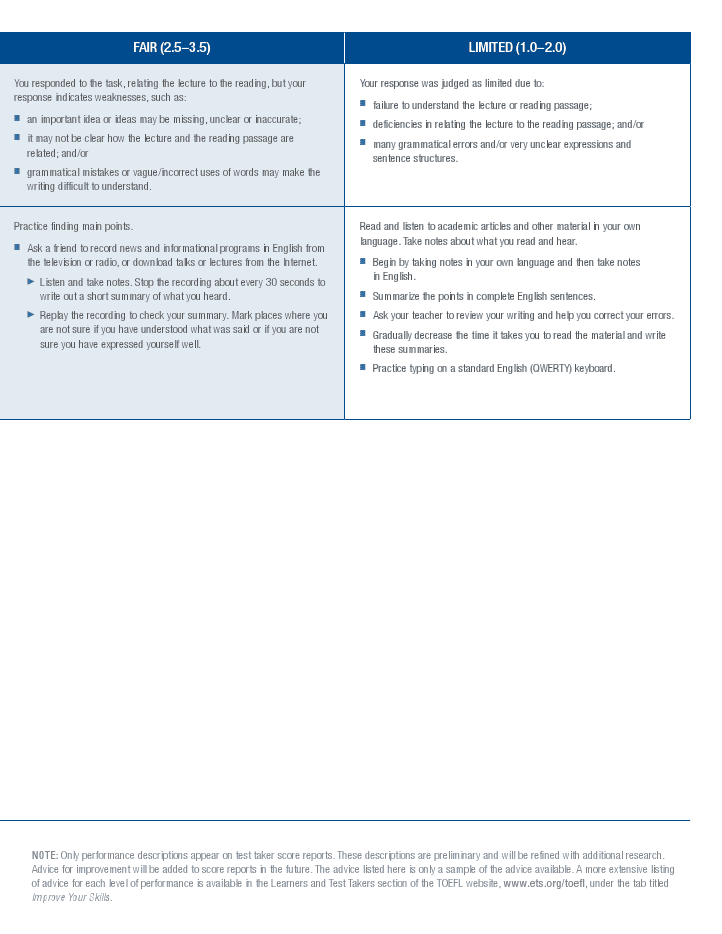
.png "TOEFL Test Skills and Sample Reading Skills, Listening Skills, Speaking Skills, Writing Based")




.JPG)


